Digital-Physical Integration in Wayfinding: Creating Seamless Phygital Experiences.
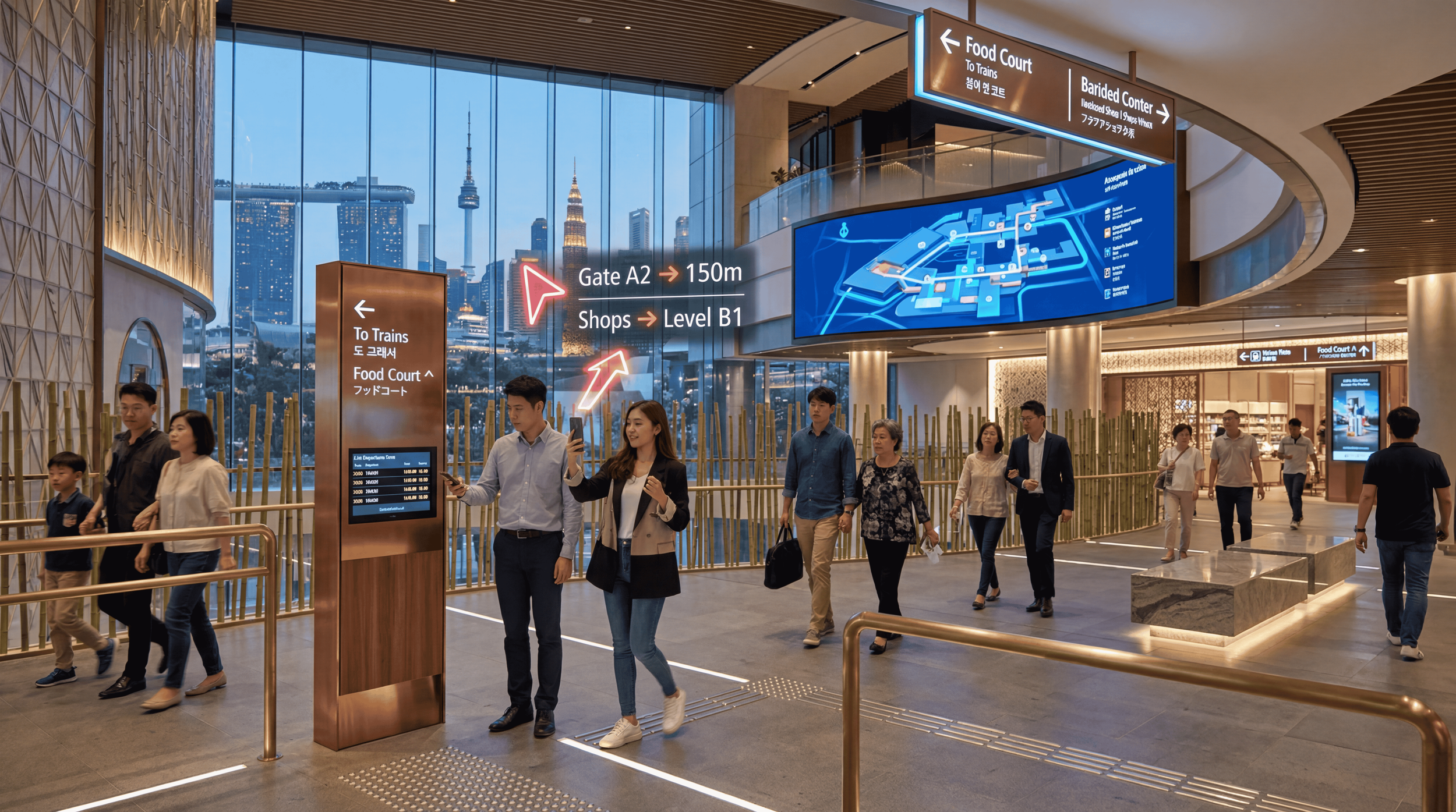
The technology to digitally augment every wayfinding experience exists.
The question is whether it should lead the strategy or follow it.
There's a conversation that happens in almost every project briefing across Asia-Pacific. The client reaches a certain point — usually after the spatial planning discussion, sometimes right after the brand identity presentation — and someone says it: "What about the app?"
It's a reasonable question. We live in a world where people navigate cities using their phones, where QR codes have become second nature, and where augmented reality can overlay digital arrows onto a live camera feed. The technology exists. Across Asia-Pacific, it exists at world-leading levels — Singapore's Smart Nation programme, Seoul's public-realm digital infrastructure, Tokyo's multilingual transit wayfinding, Shanghai's WeChat-integrated commerce, and the super-app ecosystems (Grab, GoTo, LINE) that operate as default navigation infrastructure across ASEAN.
The question is whether digital should lead the wayfinding strategy or follow it. After decades of integrated practice across some of the world's most complex destination environments — including Asia-Pacific, the world's most digitally mature wayfinding market — our answer is unequivocal: physical wayfinding must work perfectly on its own, with digital elements enhancing rather than replacing the core experience. Get that hierarchy wrong, and you've built a navigation system that fails precisely when visitors need it most. The discipline of "physical-first" matters more in digitally sophisticated markets, not less, because the temptation to over-rely on technology is strongest where the technology is most capable.
The Phygital Promise — and Its Limits
The blending of physical and digital experiences — increasingly called "phygital" — has become one of the defining trends across retail, hospitality, and destination design. The logic is compelling: digital layers can personalise navigation in ways that static signage never could, delivering turn-by-turn directions in a visitor's preferred language, adapting routes based on real-time conditions, and surfacing relevant commercial information at precisely the right moment.
Research from the 2025 Airport Experience Report found that 56% of travellers want a single app to manage services, wayfinding, and purchases — clear evidence of appetite for digitally integrated navigation. Airline app usage has risen 7% in just five years, reaching 23% of passengers. In Asian retail and transit environments, super-app integration has reached penetration rates that would surprise observers from other regions: Grab's reach across Southeast Asia, GoTo's centrality in Indonesia, and the deep WeChat integration across Chinese commercial environments demonstrate digital adoption at scale that exceeds most global markets.
But here's what the technology headlines rarely acknowledge: even in highly digital markets, the moments when navigation matters most are often the moments when digital tools fail to engage. Phone batteries die. Screen visibility drops in bright outdoor light. Hands are full of luggage, children, or shopping. Visitors are stressed, tired, or unfamiliar with the specific app the destination expects them to use. Elderly visitors, even in digitally sophisticated populations, may not engage with smartphone-based navigation in the same way as younger demographics. International visitors may not have data roaming activated. First-time visitors may be too disoriented to launch an app even if they have it installed.
These aren't edge cases. They're the majority of the navigational moments that determine whether a destination succeeds or fails — and they hold true regardless of how digitally capable the surrounding market is.
The Foundation Principle
At Creative Dialog, we approach digital-physical integration through what we call the Foundation Principle: the physical environment must function as a complete, self-sufficient navigation system. Digital tools add depth, personalisation, and data — but they sit on top of a foundation that works without them.
This isn't a philosophical position. It's a practical one, born from observing what happens when developments build their wayfinding strategy around technology rather than spatial clarity. We've seen destinations where the signage programme was deliberately minimised because "the app handles navigation." Within months, visitor complaints about navigation had become the development's most pressing operational problem, because actual app adoption — even in digitally mature markets — never approached the level required to carry the navigational load.
The Foundation Principle means that every visitor — whether they're carrying a smartphone, a toddler, or neither — can navigate confidently using only the physical cues the environment provides. Spatial logic, sightlines, landmark visibility, colour differentiation, intuitive circulation patterns, and strategically placed signage must all function without any digital supplement. The physical environment tells the story. Digital tools allow visitors who choose to engage with them to experience a richer, more personalised version of that story.
In Asia-Pacific specifically, the Foundation Principle takes on a sharper edge. The temptation to assume "the super-app handles it" is highest where super-app integration is deepest. Singapore developments where every visitor uses Grab. Indonesian malls where GoTo navigation is assumed default. Chinese precincts where WeChat is the universal interface. Each of these contexts can lead developers to under-invest in physical wayfinding on the assumption that digital infrastructure carries the navigational load. The reality is that digital infrastructure complements physical wayfinding excellence; it does not substitute for it. The most digitally sophisticated wayfinding programmes are the ones that get the physical foundation right precisely because they understand what digital can and cannot do.
Where Digital Genuinely Adds Value
Once the physical foundation is solid, digital integration becomes genuinely powerful — not as a replacement for spatial clarity but as an amplifier of it. The most effective digital-physical wayfinding systems operate across four distinct value layers.
The first is multilingual depth. A physical sign can effectively communicate in two, perhaps three languages before information density compromises legibility. A digital layer — whether via QR code, app, or kiosk — can offer navigation in fifteen languages without adding a single character to the physical signage. In Asia-Pacific's extraordinarily diverse linguistic environment, where Singapore alone operates with four official languages and inbound visitor markets routinely include Mandarin (from Greater China), Japanese, Korean, Bahasa Indonesia, Thai, Vietnamese, and Tagalog audiences, this multilingual capacity transforms accessibility without cluttering the physical environment.
The second is real-time responsiveness. Physical signage is, by nature, static. It cannot tell visitors that a particular route is temporarily closed for maintenance, that an event has changed location, or that a tenant has moved. Digital layers can surface this real-time information precisely when and where visitors need it, bridging the gap between the built environment's permanence and the destination's operational dynamism. In developments that host events, rotate seasonal programming, or manage complex tenant configurations, this responsiveness prevents the most common source of visitor frustration: following physically correct signage to a destination that has changed.
The third is personalisation. A family with young children needs different navigation priorities than a business traveller. A visitor with mobility limitations needs accessible route options that may differ from the default path. A returning visitor wants to bypass orientation information and navigate directly to familiar destinations. Digital tools can offer these personalised experiences without requiring the physical environment to accommodate every possible user scenario simultaneously.
The fourth is analytics. This is perhaps the most underappreciated dimension of digital integration. Physical wayfinding tells visitors where to go. Digital wayfinding tells operators where visitors actually went. Heat maps, dwell time data, route preferences, search queries, and engagement patterns provide the feedback loop that allows wayfinding systems to improve continuously — identifying underperforming zones, validating design decisions, and revealing opportunities that observational studies alone would miss.
The Integration Points
The art of digital-physical wayfinding lies in choosing where and how to connect the two systems. Scattered QR codes on every sign, unsupported by clear value propositions, yield minimal engagement. Strategic integration at high-value decision points can transform the visitor experience.
Arrival and orientation represent the highest-impact integration opportunity. A QR code or NFC tap point at the destination's primary entry — linking to a browser-based map that requires no app download — allows arriving visitors to instantly access a digital navigation layer on their personal device. The key is ensuring the digital experience is immediately useful without requiring registration, download, or configuration. Browser-based solutions that load in seconds outperform app-dependent systems by orders of magnitude in adoption rates because they eliminate the friction that prevents most visitors from engaging. In markets where super-app penetration is high, alternative integration through Grab, GoTo, WeChat, or LINE channels — embedding wayfinding APIs directly into the apps visitors are already using — can achieve adoption rates that standalone destination apps cannot.
Decision complexity points — major junctions, multi-level transitions, zone boundaries — represent the second tier of integration opportunity. At these points, the physical signage system provides clear directional guidance while a digital layer offers additional context: walking times, accessibility options, what's currently happening in each direction. Interactive kiosks at these decision points serve visitors who prefer a larger interface while simultaneously providing operational data about visitor flow patterns.
Point-of-interest discovery represents a commercial integration opportunity that aligns digital wayfinding with revenue generation. When visitors have oriented themselves and feel navigationally confident, digital tools can shift from direction-giving to destination-suggesting — surfacing nearby dining options, current promotions, or experiences the visitor might not have known about. This transition from navigation to discovery is where digital integration moves from operational necessity to commercial strategy.
Regional Considerations
The Asia-Pacific environment imposes specific design considerations that differentiate regional implementations from global templates — though these are considerations of refinement rather than fundamental constraints, given the world-leading digital infrastructure available across the region.
Climate and device performance. Tropical humidity, monsoon conditions, and equatorial UV affect both device performance and screen legibility in outdoor contexts. Outdoor digital kiosks across Singapore, Bangkok, Jakarta, Manila, and the wider tropical region require industrial-grade screens with sufficient brightness to compete with outdoor light, plus weather-rated enclosures designed for sustained humidity rather than dry-climate specifications. Visitor smartphones operating in humid conditions and direct equatorial sunlight can experience reduced legibility on default brightness settings — a specification consideration for any QR code or display content that visitors will read on personal devices outdoors.
Cultural engagement patterns vary substantially across the region. In Japan, where digital interfaces are highly developed but cultural protocols favour quiet, considered engagement, QR/NFC personal-device interaction often outperforms voice-activated or large-format public kiosks. In Singapore, Korea, and Hong Kong, where digital infrastructure trust is among the world's highest, app-based and super-app-integrated wayfinding can achieve adoption rates that exceed most global benchmarks. In Indonesia, the Philippines, Vietnam, and Malaysia, super-app platforms (GoTo, Grab, LINE) operate as default navigation infrastructure — making integration through these platforms more effective than building destination-specific apps. In Chinese commercial contexts, WeChat integration is essentially mandatory for any digital wayfinding programme; standalone app strategies will fail. Multi-generational family group dynamics, common across Chinese, Indian, Filipino, and Indonesian cultures, mean that digital tools often need to serve a group decision-making process rather than an individual one.
The pace of development across the region — with destinations evolving rapidly through phased openings, tenant changes, and expansion — makes real-time digital updates not a luxury but a necessity. A static signage system designed for a development's opening configuration becomes progressively less accurate as the destination evolves. Digital layers that can be updated centrally and immediately provide the operational flexibility that the region's dynamic development environment demands.
The Discipline of Restraint
Perhaps the most important skill in digital-physical wayfinding integration is knowing when not to go digital. Technology that adds complexity without adding clarity makes navigation worse, not better. Every digital element introduced into a wayfinding system must pass a simple test: does this make the visitor's journey easier, or does it make it more impressive in a pitch deck?
The distinction matters because the technology industry's incentives and the visitor's interests are not always aligned. Vendors sell features. Visitors need clarity. The most effective digital-physical wayfinding systems are notable for what they don't include as much as for what they do — resisting the temptation to deploy every available technology in favour of the precise integration points where digital genuinely serves the visitor's navigational needs.
This discipline is particularly important in digitally sophisticated markets, where the expected baseline of digital integration is high and the temptation to add layers is correspondingly strong. The destination that leads on digital wayfinding in Asia-Pacific isn't the one with the most features — it's the one whose digital layer is most precisely calibrated to the moments when digital genuinely outperforms physical.
At Creative Dialog, we approach digital-physical integration with the same strategic rigour we apply to every aspect of wayfinding design. The question is never "what technology is available?" but "what does the visitor need at this moment in their journey, and what is the most effective way to provide it?" Sometimes the answer is a beautifully designed physical sign. Sometimes it's a QR code linking to a multilingual digital map. Often, it's both working in concert — the physical providing confidence, the digital providing depth.
The destinations that get this balance right don't just navigate well. They navigate intelligently — adapting to each visitor's preferences, responding to real-time conditions, and generating the data that drives continuous improvement. That's the genuine promise of phygital wayfinding: not technology for its own sake, but technology in service of the human experience of moving through space. Where digital-physical integration is underperforming or about to enter a new project phase, our Belonging Audit™ provides a structured assessment of how your wayfinding system performs against the four dimensions of belonging: Navigate, Recognise, Connect, Dwell.
Like What Your Reading?
These articles are a small part of our research and strategic advisory Services. Get in touch with Creative Dialog today to see how we can distill these insights into actionable strategies and solutions to improve the visitor experience across your destination.
Looking for deeper analysis of the Visitor Experience economy?
Read more over at Extended Dialog.