Visitor Journey Mapping: From Arrival to Departure — Creating Cohesive Navigation Narratives.
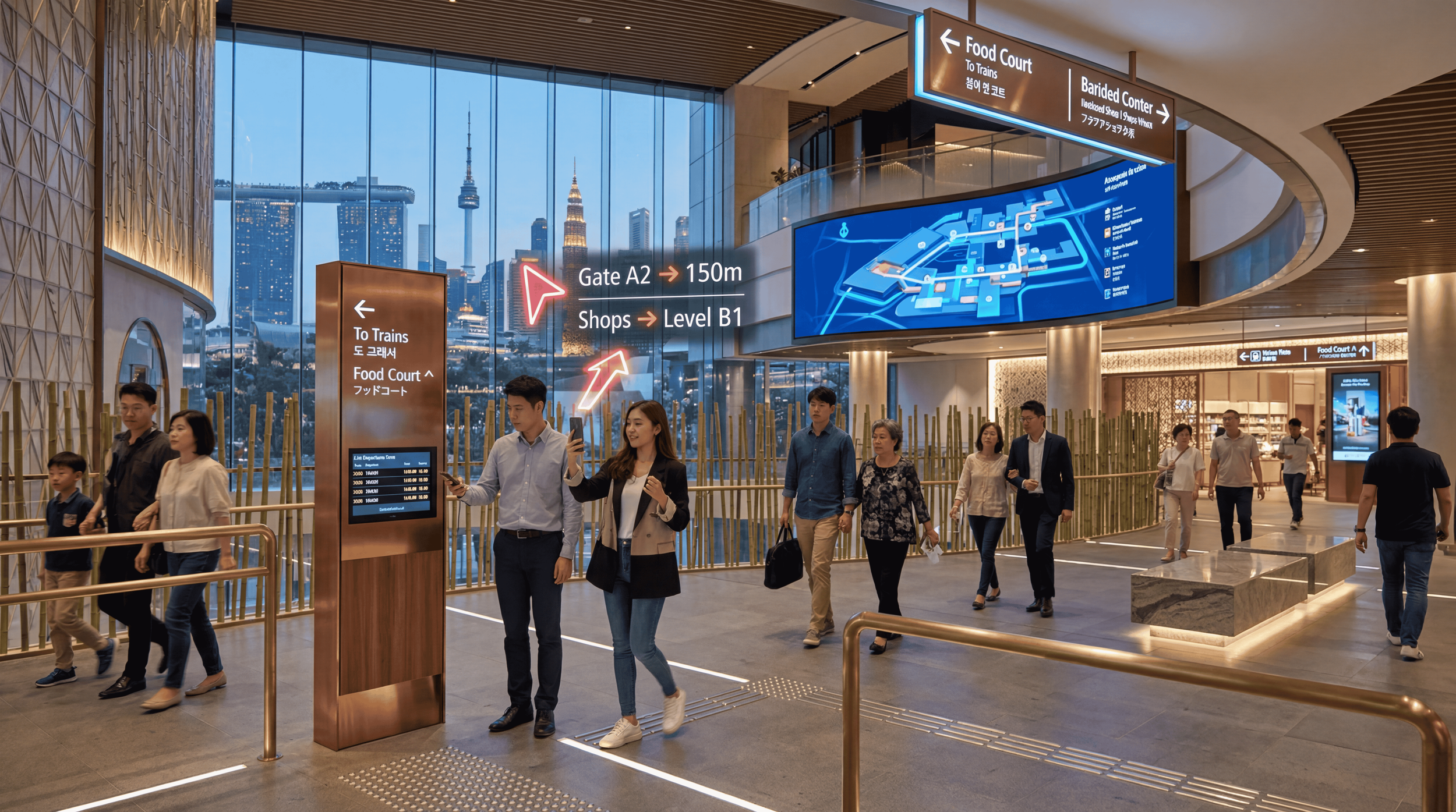
Every destination tells two stories. The first is the one its developers intended — the carefully orchestrated sequence of experiences designed to guide visitors through a curated environment. The second is the one visitors actually live — shaped by confusing parking structures, unmarked transitions, missed amenities, and the accumulated friction of dozens of small navigational failures that no one thought to anticipate.
The gap between these two stories is where visitor experience goes to die. And the discipline that closes it — visitor journey mapping applied to wayfinding — remains one of the most underused strategic instruments in destination development across Asia-Pacific.
At Creative Dialog, we've spent decades mapping the real journeys visitors take through some of the world's most complex destination environments — work now anchored in Asia-Pacific. What we've consistently found is that the destinations which perform best commercially and experientially are those that design navigation as a continuous narrative rather than a collection of isolated signage decisions.
The Pre-Arrival Blind Spot
Most wayfinding programmes begin at the front door. This is a fundamental error. The visitor's navigation experience — and their emotional relationship with the destination — starts long before they arrive. It begins the moment they search for directions online, continues through the approach drive, intensifies during parking or drop-off, and reaches its first critical test at the transition from vehicle to pedestrian.
A visitor who arrives confident — knowing where to park, how to enter, and where to orient themselves — begins their experience in exploration mode. A visitor who arrives confused — circling for parking, uncertain which entrance to use, unable to locate the attraction or venue they came for — begins in survival mode. That emotional starting point colours everything that follows.
In Asia-Pacific contexts, the pre-arrival journey carries particular complexity. Visitors may be arriving by private vehicle, taxi, ride-hailing service (Grab in Singapore, Malaysia, Indonesia, Philippines, Thailand, Vietnam; Gojek across Indonesia; LINE TAXI in Taiwan and Thailand), MRT or rail transit, dedicated airport shuttle, motorbike-taxi (a meaningful mode across Vietnam, Thailand, and Indonesia), or pedestrian arrival in walkable urban contexts.
Each mode creates a different entry experience and a different set of navigational needs. A development that provides seamless wayfinding for private vehicles but neglects the ride-hailing drop-off experience or the MRT-to-pedestrian transition has failed a growing proportion of its visitors before they've taken a single step inside.
The most effective journey design begins with the digital touchpoint — the website, app, or search result that provides the visitor's first navigational information — and traces the complete sequence through approach, arrival, entry, orientation, exploration, and departure. Each transition point matters not just for functional clarity but for emotional continuity: does the visitor maintain confidence and momentum as they move from one phase to the next, or do gaps in the navigation narrative create moments of uncertainty that erode the experience?
The Decision Architecture
A visitor journey through any complex destination involves dozens of decision points — moments where the visitor must choose between options, interpret information, or orient themselves in unfamiliar space. The quality of the experience depends not on any single decision point but on the cumulative cognitive load these decisions impose across the entire journey.
What distinguishes navigation that feels intuitive from navigation that feels exhausting is the relationship between three qualities at every decision point: clarity (can the visitor easily understand their options?), confidence (does the visitor feel certain about their choice?), and continuity (does the decision connect logically to what came before and what comes next?). When all three qualities are sustained across the journey, navigation feels effortless. When any of them fails at multiple points, the experience fragments.
This perspective reveals problems that traditional wayfinding audits routinely miss. A signage review might confirm that every individual sign is correctly placed, properly sized, and accurately labelled. But a journey-level analysis can reveal that the sequence of signs creates cognitive contradictions — a directional sign pointing left at one junction followed by a directional sign pointing right at the next, with no intermediate confirmation that the visitor is still on the correct path. Each sign is individually correct. The narrative they create together is disorienting.
In developments across Asia-Pacific, where multi-level, mixed-use environments are increasingly the norm rather than the exception, this decision architecture becomes extraordinarily complex.
A visitor navigating from a rooftop restaurant in a Singapore mixed-use development to a ground-floor retail destination might traverse multiple vertical transitions, pass through zones with different ownership and therefore different signage systems, cross indoor-outdoor climate boundaries, and encounter competing directional information from building-level and precinct-level wayfinding programmes. Without journey-level analysis that traces the complete path, these systemic failures remain invisible to everyone except the visitors who experience them.
The Orientation Moment
Every visitor journey contains a critical orientation moment — the point where the visitor first establishes their mental model of the destination. This moment typically occurs just after entry, when the visitor pauses (consciously or not) to survey their surroundings, identify landmarks, and form an initial understanding of the spatial structure they'll need to navigate.
The design of this orientation moment disproportionately influences the entire subsequent experience. Research on spatial cognition consistently demonstrates that visitors who form accurate mental models early in their journey navigate more confidently, explore more broadly, and report higher satisfaction than those whose initial orientation is confused or incomplete. The orientation moment is, in effect, the visitor's first impression of the destination's navigability — and like all first impressions, it proves remarkably persistent.
Whether a destination supports this orientation moment is determined by the spatial environment more than by any signage decision. Can the visitor see the major destination zones from their entry position? Is there a logical spatial hierarchy that communicates the destination's structure at a glance? Are landmark elements — distinctive architectural features, art installations, planted atriums, or environmental markers — visible and memorable enough to serve as anchors for the visitor's developing mental map?
In many Asia-Pacific destinations, the orientation moment is compromised by the very grandeur that makes the destination impressive. A soaring atrium that photographs magnificently can actually impair visitor orientation by presenting too much visual information at once, overwhelming the visitor's ability to extract navigational meaning from the space.
The most effective wayfinding design balances spectacle with legibility — creating arrival experiences that are both impressive and immediately comprehensible. Jewel Changi's rain vortex, for instance, achieves this balance by serving as both an unforgettable spectacle and an instantly recognisable orientation anchor that visitors use to locate themselves throughout the integrated terminal-and-retail environment around it.
Transitions as Narrative Bridges
The most common failure point in visitor journeys isn't within zones — it's between them. Transitions — from exterior to interior, from one level to another, from one precinct to the next, from one ownership domain to another — are where navigational narratives most frequently break down.
These transition failures often correspond to organisational or contractual divisions rather than experiential ones. The handoff between a development's external wayfinding and an individual building's internal system. The gap between a precinct's directional signage and a tenant's own navigation programme. The disconnect between vehicular wayfinding managed by one entity and pedestrian wayfinding managed by another.
These transition failures are particularly acute in Asia-Pacific's precinct-scale developments — Marina Bay in Singapore, Marunouchi in Tokyo, Lujiazui in Shanghai, ICONSIAM and the Chao Phraya River precincts in Bangkok, Roppongi Hills in Tokyo — where multiple stakeholders, management companies, and design consultancies are each responsible for different portions of the visitor's journey. Without a unifying perspective that holds all parties accountable to the visitor's continuous experience, each entity optimises for its own domain while no one owns the transitions between them.
The solution is treating transitions not as boundaries but as narrative bridges — designed moments that maintain the visitor's orientation, confirm their progress, and prepare them for whatever comes next.
A well-designed transition between an outdoor promenade and an indoor retail environment, for example, provides visual continuity through the climate boundary, confirms the visitor's direction of travel, and introduces the spatial logic of the interior environment before the visitor fully enters it. The transition becomes a feature of the experience rather than a gap in it.
In Asia-Pacific's tropical and sub-tropical context, these transitions carry additional significance. The movement from a conditioned 22°C interior to a humid 32°C tropical exterior, or from a sun-drenched outdoor approach into a precisely conditioned conservatory climate, is not just a navigational event — it's a physiological one. Wayfinding that accounts for thermal transitions ensures that navigational support is strongest precisely at the points where the visitor's cognitive resources are most taxed by environmental adjustment.
The Departure Equation
Most wayfinding programmes invest heavily in getting visitors into a destination and almost nothing in getting them out. This asymmetry is a strategic error. The departure experience is the visitor's final navigational interaction with the destination — the one that most strongly influences their overall memory of the experience and their likelihood of returning.
Research on the psychology of experience evaluation consistently demonstrates what behavioural scientists call the "peak-end rule": people judge an experience largely based on how they felt at its most intense point and at its end. A visitor who enjoyed hours of seamless navigation but ended their visit frustrated — unable to find their car, confused about exit routes, or uncertain about how to arrange transportation — will carry that frustration disproportionately into their overall assessment.
A well-designed departure addresses this with the same care applied to arrival. This includes clear pathways back to parking and transportation, confirmation signage that reassures visitors they're heading the right way, and transition support that maintains the destination's brand experience through the final moments. In developments with complex parking structures — common across Asia-Pacific mega-developments — and increasingly in transit-oriented contexts where the return journey involves multiple modes (parking to retail to MRT to onward connection), the departure experience often represents the single most stressful navigational episode in the entire visit.
The departure phase also represents a commercial opportunity. Visitors leaving a destination pass through spaces that can be designed for final engagement — a well-placed retail offering, a memorable art installation, or simply a beautifully designed exit sequence that reinforces the positive associations built during the visit. These departure touchpoints can contribute to the overall narrative rather than feeling like an afterthought.
From Mapping to Management
The most consequential principle in this work is that destinations are not static. They evolve through tenant changes, seasonal programming, construction phases, and shifting visitor demographics. A wayfinding system that perfectly served opening-day conditions becomes progressively less aligned with operational reality as the destination changes around it.
The most sophisticated developments treat journey-level wayfinding as a continuous practice rather than a one-time deliverable. Regular journey audits — walking the visitor's path with fresh eyes, tracking where confusion occurs, measuring where dwell times drop or visitor flows stall — provide the feedback loop that keeps wayfinding responsive to the destination's evolving reality.
This approach transforms wayfinding from a design discipline into an operational one. Rather than installing a signage system and considering the navigation challenge solved, journey-aware destinations maintain active awareness of how visitors actually experience their environment — and adjust continuously to close the gap between the intended story and the lived one.
At Creative Dialog, we approach wayfinding as a strategic narrative discipline before it is a signage one. The destinations we work with don't just have well-designed signs. They have well-told navigation stories — continuous, coherent, and confidence-building from the visitor's first digital touchpoint through their final steps back to their vehicle, train platform, or onward connection.
The destinations that invest in this narrative approach don't just navigate better. They perform better — commercially, experientially, and reputationally. Because in the end, the story a destination tells through the act of moving through it is the story visitors remember and share. And getting that story right is worth every step of the engagement.
Like What Your Reading?
These articles are a small part of our research and strategic advisory Services. Get in touch with Creative Dialog today to see how we can distill these insights into actionable strategies and solutions to improve the visitor experience across your destination.
Looking for deeper analysis of the Visitor Experience economy?
Read more over at Extended Dialog.