Retail Wayfinding That Drives Revenue: The Strategic Intersection of Navigation and Sales.
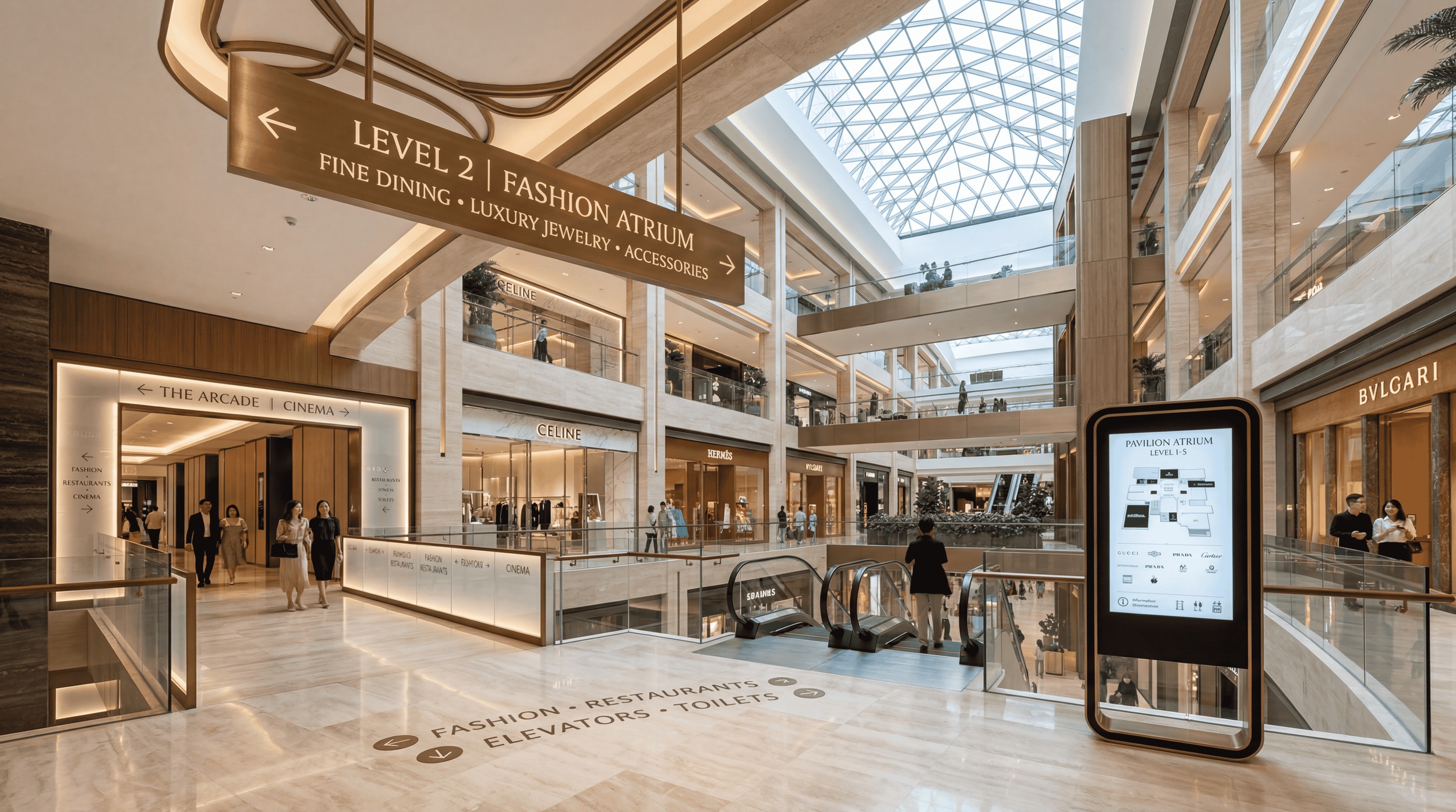
Every retail destination has a ghost number — the revenue that never materialises because visitors couldn't find what they were looking for. Research suggests that up to 38% of shoppers leave without purchasing when they can't locate products or stores, and of those who abandon a search, nearly half take their spending directly to a competitor. In an Asia-Pacific retail market valued at over $5 trillion — the world's largest, with ASEAN recovery and growth running at 7–9% annually across key markets — the financial consequence of poor navigation isn't a rounding error.
It's a strategic failure hiding in plain sight.
At Creative Dialog, our work across some of the world's most complex retail environments has consistently revealed a pattern: the destinations that treat wayfinding as a revenue strategy rather than an operational afterthought don't just perform better — they perform in fundamentally different ways. Dwell times extend, discovery increases, secondary spending rises, and tenants report stronger conversion. The connection between navigation and revenue isn't theoretical. It's measurable, and increasingly, it's decisive.
The Navigation-Revenue Connection
The economics of retail navigation rest on a simple behavioural principle: visitors who move confidently through a destination spend more time, discover more offerings, and make more purchases than those who don't. A 2024 JLL Global Retail Research report found that shopping centres with well-integrated digital wayfinding experience a 15–20% increase in dwell time. That additional time isn't passive — research from Proximity Insight indicates that shoppers who spend longer in retail environments are 25% more likely to make multiple purchases.
This principle intensifies in Asia-Pacific's mega-mall environment, where the sheer scale of destinations creates navigation challenges that smaller-format retail rarely encounters. ICONSIAM in Bangkok attracts approximately 50 million visitors annually across more than 750,000 square metres of riverside retail and cultural programming. VivoCity in Singapore — the gateway to Sentosa and one of the city-state's busiest destinations — handles over 55 million visitor footfalls. Marina Bay Sands' shoppes integrate retail with hospitality, gaming, and cultural programming on a scale that demands wayfinding performance equal to its architectural ambition. ION Orchard, K11 Musea in Hong Kong, Pavilion KL, Siam Paragon, and the giants of Tokyo and Shanghai all operate at scales where the distance between a visitor's intention and their action is measured not just in metres but in cognitive load — the mental energy required to process spatial information, make navigation decisions, and maintain orientation in complex environments.
When that cognitive load exceeds a comfortable threshold, visitors default to familiar routes, bypass discovery opportunities, and ultimately curtail their visit. The revenue implications compound across every tenant, every floor, and every day of operation.
Why Traditional Signage Thinking Falls Short
Most retail wayfinding programmes begin and end with signage — directional pylons, overhead directories, and floor-mounted store listings. These elements serve a basic functional purpose, but they fundamentally misunderstand how visitors actually navigate large-scale retail environments.
Survey data from Custom Neon's 2025 retail study found that 73% of shoppers experience frustration when they can't find items in store, yet when asked what would most improve their experience, nearly 75% pointed to organised layouts and ease of finding things — significantly ahead of factors like pleasant décor or helpful staff. The distinction matters: visitors aren't asking for more signs. They're asking for environments that make intuitive sense.
This is particularly relevant for Asia-Pacific retail destinations, where the visitor demographic spans dozens of nationalities, multiple languages, and vastly different spatial navigation traditions. Singapore alone operates with four official languages — English, Mandarin, Malay, and Tamil — before the inbound visitor markets across the region, including Mandarin-speaking tourists from Greater China, Japanese, Korean, Bahasa Indonesia, Thai, Vietnamese, and Tagalog audiences, are layered on top. A directional sign that works for a regular local visitor may create confusion for a first-time international tourist navigating the same space. Strategic wayfinding addresses this complexity not through more signage but through environmental design that reduces the need for signage in the first place — clear sightlines, logical spatial hierarchies, distinctive zones that visitors can identify and remember, and journey sequences that reveal a destination progressively rather than presenting it all at once.
The Discovery Architecture Principle
The most commercially successful retail wayfinding doesn't simply get visitors to their intended destination efficiently. It exposes them to additional opportunities along the way. We think of this as discovery architecture — the deliberate design of navigation paths that create commercial exposure without compromising the visitor's sense of agency or comfort.
This approach draws on a principle well understood in digital commerce: the difference between a search-driven and a browse-driven experience. In physical retail, most visitors arrive with a primary purpose — a specific store, a meal, a particular purchase. Discovery architecture ensures that the journey to that primary purpose passes through or alongside complementary offerings that encourage spontaneous engagement.
ICONSIAM exemplifies the principle at scale. Its SOOK SIAM heritage hall — a curated indoor "floating market" celebrating Thai craft, food, and cultural performance — is positioned not as a side attraction but as a destination zone that visitors traverse on natural circulation paths. The result is that international tourists arriving for luxury retail discover Thai craft culture, and local visitors arriving for the cultural programming discover global retail brands. Neither audience feels diverted. Both feel they've discovered something. That dual-discovery dynamic is the discovery architecture principle made physical.
The financial impact is substantial. Developments that integrate experiential placemaking elements with navigation strategy consistently report higher secondary spending. When visitors encounter something unexpected and interesting during a purposeful journey — a well-positioned F&B concept, a curated retail experience, an engaging public space — the psychological shift from "getting somewhere" to "being somewhere" creates commercial opportunity that pure efficiency-focused wayfinding would eliminate.
In Asia-Pacific's tropical-climate retail environment, this principle extends to how indoor and outdoor transitions are managed. Destinations that create comfortable, navigable connections between air-conditioned interiors and activated outdoor precincts — particularly during the more temperate evening hours and around monsoon seasonality — effectively expand their commercial footprint without expanding their floor area. Singapore's covered linkway network, connecting MRT stations to surrounding precincts through thermoneutral corridors, is one of the world's most sophisticated answers to tropical pedestrian retail navigation. The wayfinding system becomes the mechanism through which this expanded territory is made accessible and inviting.
Data-Informed Navigation Strategy
The evolution of retail analytics has transformed what's possible in wayfinding strategy. Heat mapping, foot traffic analysis, and dwell-time tracking now provide granular insights into how visitors actually move through retail environments — insights that frequently contradict assumptions about preferred routes and high-traffic zones.
This data reveals patterns that traditional planning often misses. Dead zones where foot traffic drops despite proximity to anchor tenants. Circulation bottlenecks that force visitors into narrow decision corridors. Secondary routes that carry far more traffic than their design intended. Each of these patterns represents both a navigation problem and a commercial opportunity.
Strategic wayfinding uses this data to optimise visitor flows in ways that serve both operational efficiency and revenue generation. Rather than routing all traffic past the same high-rent frontages, informed navigation design distributes visitors more evenly throughout a development — reducing congestion in primary corridors while activating underperforming zones that currently generate lower rental yields because of perceived inaccessibility.
For landlords and asset managers, this rebalancing directly impacts tenant performance and, consequently, leasing strategy. When previously marginal locations become genuinely accessible through improved wayfinding, the conversation about rental premiums shifts. The wayfinding investment pays for itself not through tenant satisfaction surveys but through demonstrable improvements in foot traffic distribution and conversion rates across the portfolio.
The Tenant Ecosystem Effect
Retail wayfinding doesn't operate in isolation — it shapes the ecosystem dynamics between tenants. When anchor destinations are easy to locate but secondary offerings remain hidden behind poor navigation, the development creates a two-tier tenant economy where flagship stores absorb disproportionate visitor attention while smaller, often more distinctive operators struggle for visibility.
This dynamic is particularly damaging in mixed-use developments where the diversity of offerings is itself a competitive advantage. A development's ability to attract and retain independent retailers, emerging brands, and distinctive F&B concepts depends partly on whether those operators can achieve viable foot traffic without the benefit of a prime anchor-adjacent location. Strategic wayfinding levels this playing field by ensuring that the navigation system itself functions as a tenant equaliser — directing visitors toward discovery opportunities that reflect the full breadth of the development's offering rather than just its most prominent tenants.
The implications for leasing strategy are significant. Developments with strong wayfinding systems can command competitive rents across a broader range of unit positions because they can demonstrate to prospective tenants that visibility isn't solely a function of location — it's a function of how effectively the development guides visitors through its entire offering. In Asia-Pacific's increasingly competitive retail landscape, where independent F&B concepts, emerging local brands, and curated lifestyle operators are often the differentiators that distinguish a destination from a generic mall, this tenant equalisation is more than a leasing optimisation. It is a competitive moat.
From Cost Centre to Revenue Driver
The shift from viewing wayfinding as a facilities cost to recognising it as a revenue strategy requires a change in how developments measure its impact. Traditional wayfinding metrics — signage visibility, directory accuracy, complaint frequency — capture compliance but miss value creation. Revenue-aligned metrics tell a different story: changes in dwell time by zone, secondary spending per visit, foot traffic distribution ratios, and tenant conversion rates before and after navigation improvements.
In the intensely competitive Asia-Pacific retail landscape — where China leads the regional market, Japan and Korea anchor the developed-market premium, India scales rapidly, and Singapore competes on per-capita retail density — the ability to extract more commercial value from existing visitor flows represents a significant competitive advantage. New developments can be designed with discovery architecture from the outset. Existing destinations can be retrofitted with navigation strategies that unlock underperforming areas and redistribute commercial opportunity more effectively.
At Creative Dialog, our approach to retail wayfinding begins not with signage design but with commercial strategy. We map visitor behaviour, identify revenue leakage points, and design navigation experiences that align spatial design with business objectives. The result isn't just a development where visitors can find their way — it's a destination where the act of finding their way becomes, in itself, a commercially productive experience.
The destinations that understand this distinction are the ones whose tenants thrive, whose visitors stay longer, and whose asset performance consistently outpaces developments that treat wayfinding as merely a question of where to put the signs. Where retail wayfinding is underperforming or about to enter a new project phase, our Belonging Audit™ provides a structured assessment of how your destination performs against the four dimensions of belonging: Navigate, Recognise, Connect, Dwell.
Like What Your Reading?
These articles are a small part of our research and strategic advisory Services. Get in touch with Creative Dialog today to see how we can distill these insights into actionable strategies and solutions to improve the visitor experience across your destination.
Looking for deeper analysis of the Visitor Experience economy?
Read more over at Extended Dialog.