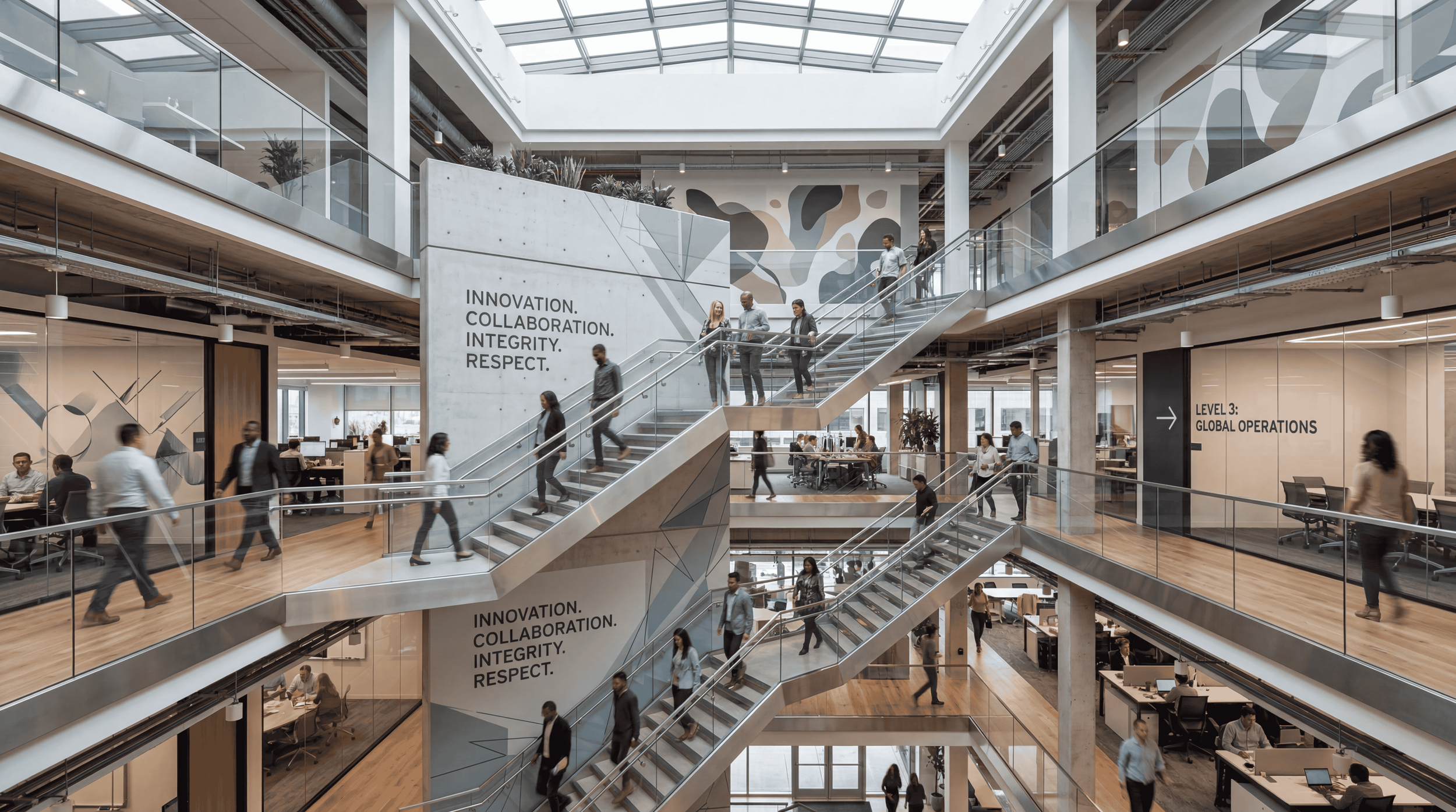
The principles of strategic environmental design apply with as much rigour to a corporate headquarters as to a destination. In Asia-Pacific's competitive talent markets, the workplace is no longer a backdrop — it is a strategic asset that organisations either invest in or accept the cost of ignoring.
Walk into the reception of most corporate offices across Singapore, Hong Kong, Tokyo, or Bangkok and you can read the organisation's investment in its workplace within thirty seconds. There's the company name in metal letters above a reception desk. A pendant light. A wall colour vaguely aligned to brand guidelines. Perhaps a corporate timeline framed near a sofa. Then step past reception, and the brand expression evaporates. Corridors feel generic. Meeting rooms are interchangeable. The environment that employees and visitors actually inhabit bears no meaningful relationship to the organisation's identity, values, or strategic aspirations.
This pattern is universal across the region's commercial real estate market. It is also a missed opportunity of substantial commercial consequence — particularly for organisations competing for talent in cities where employer brand perception is one of the most-cited factors in candidate decision-making, and where the workforce includes professionals who have abundant options and high expectations of the environment they're being asked to inhabit.
At Creative Dialog, our integrated practice in wayfinding, placemaking, and destination branding extends naturally into workplace environments because the underlying discipline is the same: physical environments shape human behaviour, and strategically designed environments shape it in ways that serve specific objectives. The question for any organisation is not whether your workplace influences how people feel and perform. It's whether that influence is intentional or accidental — and whether the result is a competitive advantage or a compounding cost.
From Decoration to Strategic Platform
Workplace branding has evolved through three distinct phases, each reflecting a deeper understanding of the relationship between environment and performance.
The first generation treated workplace branding as an identity exercise. Corporate colours on accent walls. Logos on glass partitions. Brand imagery in common areas. Decorative but largely inert. The environment signalled corporate identity without influencing how people worked or how they felt about the organisation. It was, essentially, decoration applied to a generic spatial container.
The second generation recognised that spaces could be designed to encourage specific behaviours. Collaboration zones, quiet focus areas, hot-desking neighbourhoods, and innovation labs emerged as spatial responses to how organisations wanted their people to work. This was meaningful progress, but the second-generation approach often produced environments that looked like every other "modern workplace" regardless of the organisation inhabiting it. The aesthetic became globally homogenised — a Singapore tech office could be transplanted to Stockholm or Sydney without any visible adjustment, and that interchangeability became, in itself, a problem.
The current generation — and where the real competitive advantage lies — treats the workplace as a strategic platform that aligns physical space, organisational culture, business objectives, and the cultural register of the place in which the organisation operates. This approach doesn't just ask "what does our brand look like?" It asks: "What does our organisation feel like to inhabit, and how does that feeling advance our strategic goals in this specific market?"
The difference is substantial. Organisations that approach workplace branding strategically — connecting environmental design to cultural objectives, talent strategy, and operational performance — consistently report meaningfully higher talent retention, stronger employee advocacy, and improved alignment between stated values and daily behaviour. In Asia-Pacific's competitive talent markets — Singapore, Hong Kong, Tokyo, Seoul, increasingly Bangkok and Ho Chi Minh City — these aren't marginal improvements. They represent material business advantage in cities where talent decisions are increasingly made on environmental quality alongside compensation.
Cultural Excavation Looks Different in Asia
Effective workplace branding starts where good destination branding starts: with understanding what's authentically true about the organisation before designing anything.
This means going beyond brand guidelines to examine how the organisation actually operates. What behaviours distinguish its culture from competitors? What values genuinely guide decision-making versus which ones merely decorate the careers page? How do people naturally gather, collaborate, and share knowledge? What rituals and routines define the organisational rhythm?
But Asian workplace contexts add a dimension that Western or Gulf workplace design templates routinely miss: the cultural register of the arrival, hospitality, and social spaces matters in ways that materially affect how employees and visitors experience the organisation.
Consider the threshold. In Japanese workplace culture, the genkan — the transition zone between outdoor and indoor, where shoes are removed and identity is consciously shifted from public to private — carries deep cultural resonance. Even in international corporate offices in Tokyo or Osaka, the quality of the entry sequence, the moment of transition, the cleanliness and order of the threshold zone, signals the organisation's respect for the people entering. A Japanese workplace that treats arrival as a perfunctory pass through a security gate communicates something different from one that designs the entry as a deliberate, dignified transition. These are not aesthetic preferences. They are cultural protocols that shape how people read the organisation.
Or consider hospitality. In Singapore, where the kopitiam tradition of communal coffee and conversation underpins how relationships are built across generations, the kopi or tea offering at the start of any meeting carries weight that imported Western "would you like a glass of water?" protocols simply do not. International firms that translate this into their workplace design — proper tea-and-coffee service in reception, considered seating that invites conversation rather than transaction, materials that signal warmth rather than corporate sterility — communicate cultural literacy that strengthens every subsequent interaction. Those that don't communicate something else: that the office exists in Singapore but is not really of Singapore.
The traditional Malay and Peranakan reception spaces — with their generous proportions, considered material palettes, and rituals of welcoming guests across thresholds — offer further reference for how arrival zones can be designed to feel native rather than imported. Kampung house verandahs, with their deep shade and gradual transition from external to internal climate, suggest spatial logics that translate beautifully into contemporary tropical offices where the journey from street to working desk should feel like a sequence of considered transitions rather than a sudden mechanical compression.
These references are not décor. They are spatial intelligence about how Asian audiences experience environments — and they distinguish workplaces that organisations occupy in Asia from workplaces that organisations belong to in Asia.
The international firms that get this wrong typically import workplace templates wholesale — the standard open-plan office that could exist anywhere — without asking whether these spatial solutions actually serve their particular culture, climate, and the cultural expectations of the workforce they're trying to attract. The firms that get it right start with cultural understanding and design outward from there. The result is workplaces that signal, through their material, spatial, and ritual decisions, that the organisation has bothered to understand the place it operates in. That signal is not subtle. Local talent reads it instantly.
Wayfinding as Behavioural Architecture
One of the most overlooked dimensions of workplace branding is how people navigate and orient themselves within the environment. In large corporate campuses, multi-floor headquarters, and mixed-use developments where offices integrate with retail and hospitality — increasingly common across Singapore's CBD, Hong Kong's Central, and the major Tokyo, Seoul, and Bangkok commercial districts — workplace wayfinding becomes a significant factor in both operational efficiency and brand experience.
This is where our destination wayfinding expertise translates directly into workplace work. Strategic workplace wayfinding goes beyond functional signage to create orientation systems that reinforce organisational structure, support flexible working patterns, and express brand personality through materiality, typography, and interaction design. When someone navigating your building encounters wayfinding elements that feel coherent with your organisational identity — that use materials, language, and design approaches consistent with your brand character — the cumulative effect is an environment that feels intentional rather than assembled.
Our work for StoneX in Singapore demonstrates this integration. The brief required environmental branding and Front-of-House signage that would express the firm's corporate identity at scale across its Singapore office while respecting the architectural restraint of the contemporary interior. The result was a workplace where corporate brand presence and architectural sophistication coexist — a Singapore office that is unmistakably StoneX, without sacrificing the contemporary refinement of the interior environment. The wayfinding system, environmental graphic decisions, and brand-anchored material palette work together as a coherent expression of the firm's identity rather than as separate disciplines layered onto the architecture.
For Empyrion Digital in South Korea, the discipline took a different form. As a data centre operator expanding across Asia from a Gangnam launch site, Empyrion needed Front-of-House identification, environmental graphics, and a comprehensive guidelines document that could be applied consistently across multiple future sites. The work involved not just designing for one location but encoding a brand-anchored wayfinding system that other operators and contractors could deploy elsewhere — multilingual signage treatments combining Korean and Latin script, environmental graphic schemes, and identification standards that travel with the brand as it scales. Workplace branding at this scale becomes operational infrastructure as well as identity expression.
For a confidential international technology client in Manila, the work spanned six floors of office expansion, with wayfinding strategy and themed environmental graphics anchoring each floor in topical themes drawn from local Filipino culture and digital lives. The brief recognised something important about Asian workplace work: international firms increasingly want their regional offices to express genuine connection to the local context, not merely operate within it. Wall graphics that reference Filipino cultural narratives, integrated with operational wayfinding that supports the navigation of a multi-floor workplace, deliver both — the firm's regional commitment made physical, and the practical orientation of the people who work there each day.
The pattern across these three engagements is consistent: workplace wayfinding is not a sub-set of signage. It is an integrated discipline that combines spatial logic, brand expression, cultural literacy, and operational utility — and when done well, it does work that no single discipline alone can deliver.
Sensory Translation and the Tropical Office
The most compelling workplace environments engage multiple senses in service of brand expression — not as gimmickry, but as thoughtful translation of organisational character into environmental experience.
Acoustic design determines whether a workplace feels energetic or contemplative, collaborative or focused. Material choices communicate whether an organisation values permanence or agility, craft or technology, warmth or precision. Lighting strategies establish emotional tone that influences both mood and productivity. Even olfactory elements — the quality of air, the scent in a social zone — contribute to the cumulative sense of place that employees and visitors experience.
In Asia-Pacific's tropical and sub-tropical climates, the relationship between interior and exterior environments adds another dimension. Workplaces that thoughtfully manage the transition from humid outdoor heat to conditioned interiors — through graduated climate zones, integrated covered walkways connecting MRT stations to office buildings, views to shaded courtyards or green walls, and connection to natural elements — create environments that acknowledge regional reality while providing the comfort that supports productivity. Singapore's sophisticated covered linkway network, which connects rail transit to surrounding office precincts through climate-controlled corridors, represents one of the world's most considered answers to tropical commuter wayfinding. Workplaces that design their entry sequences to integrate with this infrastructure — rather than treating the office building as an island disconnected from the urban realm — extend the workplace experience beyond the building's footprint and into the city itself.
Monsoon resilience adds a further design constraint. Materials, finishes, and entry zones in tropical Asia must perform under year-round humidity, sudden tropical rainfall, and the thermal cycling that monsoon transitions impose. Workplace branding decisions that look elegant in renders but fail under tropical climatic load become maintenance liabilities within months of occupation. Material literacy — the kind that comes from having delivered workplace projects across the region's diverse climate zones — is part of what distinguishes workplace branding work that lasts from work that requires expensive retrofit within the first lease cycle.
Measuring What Matters
Unlike many branding investments, workplace brand effectiveness can be measured through concrete metrics tied directly to business objectives. Utilisation patterns across different space types reveal whether design intentions match actual behaviour. Employee perception surveys track alignment between environment and values. Talent acquisition and retention data provide direct evidence of workplace brand impact on competitive positioning.
The most sophisticated organisations also track qualitative indicators: how employees describe their workplace to external contacts, whether the environment supports or hinders the work modes that matter most, and how visitors perceive the organisation based on their spatial experience. These insights inform ongoing refinement — treating workplace branding as an evolving system rather than a one-time design exercise.
In Asia-Pacific, where the talent market data shows particular sensitivity to workplace quality among under-35 professionals, where flexible and hybrid working models have become permanent rather than transitional, and where international firms are competing for regional talent against well-resourced local champions, the measurement discipline matters. The workplace investment that pays for itself does so through measurable improvements in retention, recruitment efficiency, and the productivity gains that come from environments people actually want to inhabit.
The Strategic Imperative
As Asia-Pacific's economies continue to differentiate and competition for talent intensifies, the organisations that treat their physical environments as strategic assets will secure meaningful advantages. This doesn't require extravagant budgets — it requires strategic thinking that connects environmental design to organisational objectives with the same rigour applied to any other business investment.
The workplaces that result from this approach don't just look different from generic corporate environments. They actively shape the behaviours, attitudes, and interactions that drive organisational success. They express authentic identity rather than borrowed aesthetics. They support regional work patterns and cultural protocols rather than importing international templates wholesale. And they communicate to every person who enters — employee, client, or visitor — what this organisation values and how it intends to operate in this place, with this workforce, at this moment in the region's economic story.
That's not interior decoration. That's competitive advantage made physical — and increasingly, in Asia-Pacific's talent-driven markets, it's the kind of advantage that compounds. Where your workplace environment is underperforming against the strategic role it should play, our Belonging Audit™ provides a structured assessment of how your workplace performs against the four dimensions of belonging: Navigate, Recognise, Connect, Dwell.
Like What Your Reading?
These articles are a small part of our research and strategic advisory Services. Get in touch with Creative Dialog today to see how we can distill these insights into actionable strategies and solutions to improve the visitor experience across your destination.
Looking for deeper analysis of the Visitor Experience economy?
Read more over at Extended Dialog.