The Psychology of Navigation: Understanding Visitor Decision-Making at Critical Waypoints.
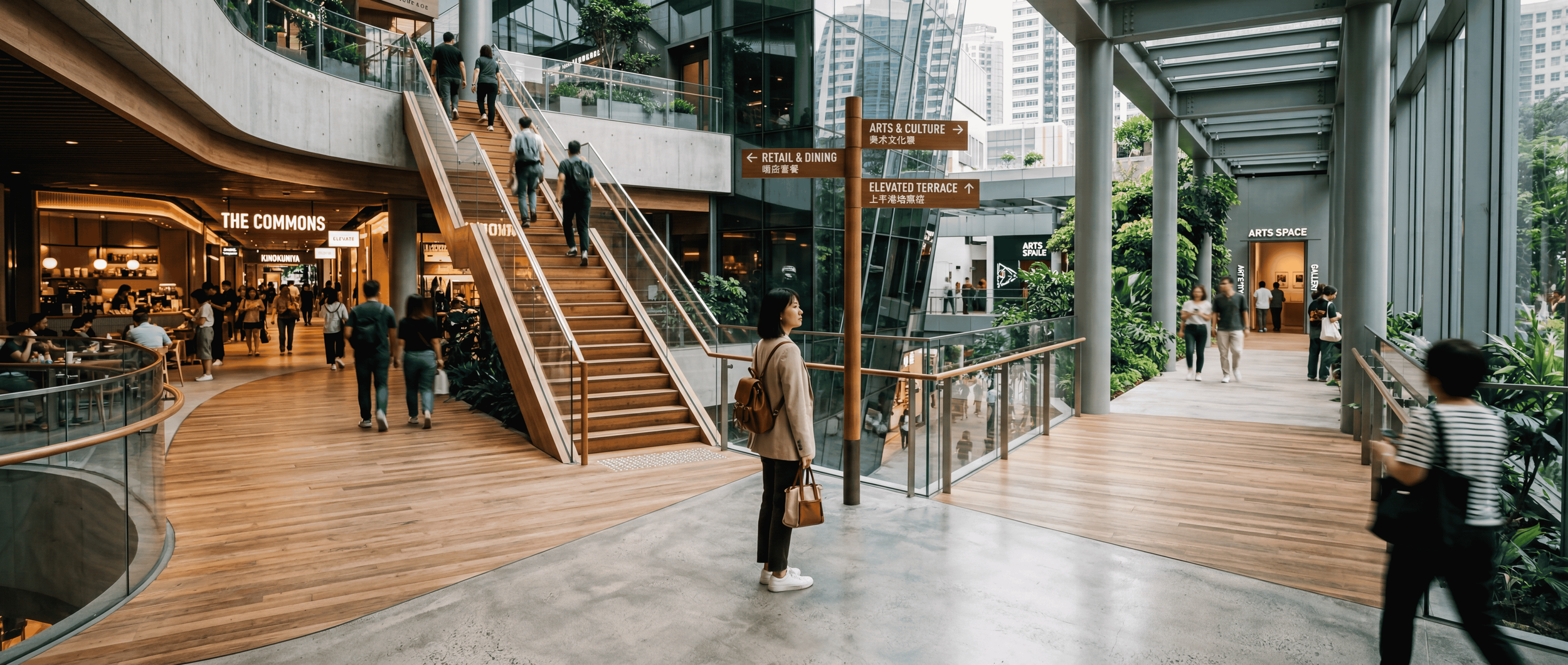
There's a moment that occurs thousands of times each day in every major development across Asia-Pacific — a visitor reaches a junction, pauses, and makes a decision. Left or right. Up or down. Continue or retreat. That pause, often lasting just two or three seconds, is the most consequential and least understood moment in destination design. It's the point where psychology, spatial design, and commercial outcomes converge, and where the quality of a visitor's experience is quietly determined.
At Creative Dialog, decades of integrated visitor experience practice across some of the world's most complex destination environments — now applied across Asia-Pacific — have taught us that understanding why people navigate the way they do matters far more than simply telling them where to go.
Wayfinding isn't a signage exercise — it's a behavioural science applied to physical space. And the destinations that grasp this distinction consistently outperform those that don't.
How Visitors Actually Navigate.
The cognitive science of wayfinding reveals a process far more complex than it appears from the outside. Research published in Cognitive Research: Principles and Implications describes navigation as drawing upon prospective planning, spatial memory, location recognition, and real-time decision-making — all operating simultaneously, often below conscious awareness. Visitors don't simply follow signs. They construct and continuously update mental models of their environment, making predictions about what lies ahead and adjusting their behaviour based on whether those predictions are confirmed or contradicted.
This means that navigation is fundamentally an act of prediction, not reaction. Visitors approaching a decision point have already begun forming expectations about what they'll find based on environmental cues — architectural form, light quality, sound, the behaviour of other people, and the rhythm of the spaces they've already passed through. When those expectations are met, navigation feels effortless. When they're violated, confusion sets in, cognitive load spikes, and the visitor's emotional relationship with the destination shifts from exploration to survival.
Research from the journal Psychological Research identifies at least five distinct cognitive strategies people employ at intersections and decision points. Some visitors favour the least-decision-load strategy — choosing paths with fewer subsequent choices to minimise cognitive effort. Others follow the least-angle strategy, selecting routes that deviate minimally from the perceived direction of their goal. Still others prefer the initial-segment strategy, choosing paths with long, straight opening stretches. These strategies aren't conscious choices — they're deeply ingrained cognitive patterns that vary between individuals and cultural backgrounds.
For destination designers, this diversity of navigation strategies has a critical implication: there is no single "correct" wayfinding solution. A system designed to serve only one navigation style will inevitably confuse or frustrate visitors who process spatial information differently. The most effective wayfinding environments accommodate multiple strategies simultaneously through spatial design that provides both clear linear routes and opportunities for intuitive exploration.
The Cognitive Load Threshold.
Every visitor carries a limited budget of cognitive resources. Navigation consumes a portion of that budget — and the more it consumes, the less remains for everything else: noticing retail displays, engaging with programming, making purchasing decisions, or simply enjoying the experience of being in a place.
The concept of cognitive load is well established in psychology. Research from Paas and colleagues defines it as the limited capacity of working memory to process diverse information simultaneously. Applied to wayfinding, the principle is straightforward: environments that demand excessive cognitive effort for navigation leave visitors mentally depleted for the activities that actually generate value — both experiential and commercial.
A 2023 study in the Journal of Environmental Psychology found that environmental cognitive load directly increases spatial anxiety, which in turn impairs navigation performance. This creates a negative feedback loop: confusing environments make visitors anxious, anxiety further impairs their ability to navigate, and the resulting frustration colours their entire perception of the destination. The study demonstrated that this effect operates through both egocentric navigation (following routes) and allocentric navigation (building mental maps), meaning it impacts visitors regardless of their preferred navigation strategy.
In Asia-Pacific's large-scale developments — Singapore's mixed-use precincts where covered linkways connect MRT stations to retail to office to hospitality, Tokyo's vertically-stacked transit-oriented developments where ten-storey commercial complexes integrate directly with rail terminals, Bangkok's mega-malls where Skytrain-connected destinations span multiple city blocks, Seoul's underground commercial networks beneath major transit interchanges — the cognitive load challenge is amplified by scale, multilingual requirements, and the additional processing demands of unfamiliar environments for international visitors.
When a first-time visitor must simultaneously process directional signage across multiple scripts (Latin, Chinese characters, Hangul, Thai, Japanese kana and kanji depending on the city), manage climate transitions between conditioned interiors and humid exteriors, interpret unfamiliar spatial layouts, and maintain orientation across multiple levels often connected by escalators, lifts, and pedestrian bridges, the cognitive demands can rapidly exceed comfortable thresholds.
The visible symptoms are familiar to anyone who manages these environments: visitors clustering near entrances rather than dispersing into the development, repeated circuits through the same areas, growing reliance on staff for directions, and ultimately, abbreviated visits. The invisible cost is the revenue, engagement, and positive perception that evaporates when cognitive overload converts explorers into survivors.
Decision Points as Design Opportunities.
If the pause at a junction is the moment where visitor experience is won or lost, then the design of decision points becomes one of the most consequential elements of destination planning. Research on spatial decision dynamics, published in Cognitive Research, found that pedestrians begin making turn decisions well before reaching an intersection — they orient themselves toward their intended direction while still approaching the decision point, particularly as they become more familiar with an environment.
This finding has profound implications for wayfinding design. It means that the information visitors need at a decision point must be available not at the junction itself but in the approach to it. By the time a visitor stands at a crossroads reading a directional sign, they've already experienced the cognitive disruption of uncertainty. Effective wayfinding prevents that disruption by providing spatial cues — sightlines, architectural differentiation, changes in light or material — that allow visitors to make navigation decisions while still in motion.
The most successful developments we've worked with treat decision points not as problems to be solved with signage but as opportunities for experience design. A well-designed junction offers visitors a moment of orientation that reinforces their mental model of the destination, provides a glimpse of what lies ahead in each direction, and creates a sense of agency — the feeling that they're choosing their path rather than being directed through it.
This distinction between choosing and being directed is psychologically significant. Research consistently shows that visitors who feel they're making active navigation choices engage more deeply with their surroundings, develop stronger spatial knowledge, and report higher satisfaction than those who feel passively guided.
The Social Dimension of Wayfinding.
One of the most under-appreciated aspects of navigation psychology is its social dimension. A comprehensive framework published in Frontiers in Psychology argues that wayfinding is, in most real-world contexts, fundamentally a social activity — influenced by the presence, behaviour, and decisions of other people even when we're not consciously aware of it.
Visitors follow the movement patterns of crowds. They use the presence of other people as a proxy for destination quality — a busy corridor signals that something worth visiting lies ahead, while an empty one suggests otherwise. They navigate differently when accompanied by family or friends than when alone, and their navigation decisions are influenced by social norms around group movement, family hierarchy, and cultural expectations about public behaviour.
Across Asia-Pacific, where retail and entertainment destinations function as primary social gathering spaces and where multi-generational family groups — common across Chinese, Indian, Indonesian, Filipino, and Thai cultural contexts — represent a significant proportion of visitors, this social dimension of wayfinding takes on particular importance.
Navigation systems that work for an individual visitor may create confusion for a family group navigating with elderly members, young children, and varying familiarity with the destination. The successful wayfinding environment accounts for these social dynamics not through more complex signage but through spatial design that naturally accommodates different group configurations and movement patterns.
From Cognitive Science to Commercial Strategy.
The practical application of navigation psychology to destination design follows a consistent logic: reduce unnecessary cognitive load, support diverse navigation strategies, design decision points as experiences rather than interruptions, and account for the social context in which most real-world navigation occurs.
Developments that apply these principles don't just see improvements in visitor satisfaction scores. They see changes in measurable commercial indicators — extended dwell times as visitors explore more confidently, increased secondary spending as cognitive resources freed from navigation are redirected toward engagement, more even distribution of foot traffic as previously hidden areas become naturally discoverable, and stronger repeat visitation as positive navigation experiences build the kind of spatial familiarity that makes return visits comfortable and rewarding.
This is where cognitive science meets asset performance. Every confusing corridor, every unmarked decision point, every spatial layout that demands excessive mental effort isn't just a visitor experience problem — it's a revenue leak. And every intervention that makes navigation more intuitive, more comfortable, and more human isn't just good design — it's sound commercial strategy.
At Creative Dialog, we approach wayfinding through this behavioural lens. We study how people actually move through spaces, not how plans suggest they should. We design for the psychology of real visitors — with their diverse navigation strategies, their limited cognitive budgets, their social contexts, and their emotional responses to uncertainty.
The result is destinations where navigation feels effortless not because visitors are being directed but because the environment itself makes sense. And in our experience, environments that make sense are environments that make money.
Like What Your Reading?
These articles are a small part of our research and strategic advisory Services. Get in touch with Creative Dialog today to see how we can distill these insights into actionable strategies and solutions to improve the visitor experience across your destination.
Looking for deeper analysis of the Visitor Experience economy?
Read more over at Extended Dialog.