Healthcare Wayfinding: Reducing Anxiety Through Compassionate Navigation Design.
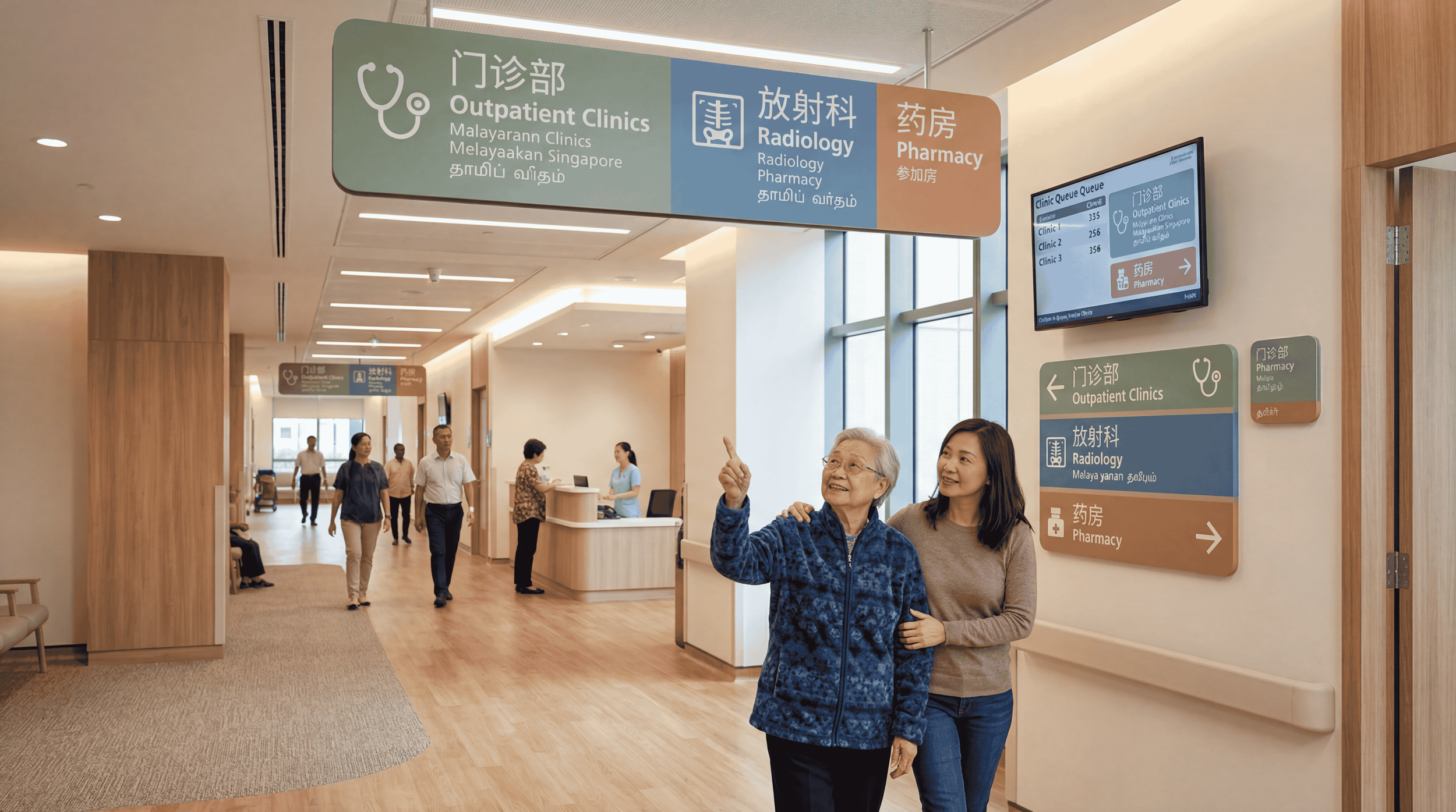
For patients arriving at a hospital, navigation is rarely the primary concern. Pain, fear, uncertainty, and the cognitive compromise of illness or injury all precede the question of which way to go. Yet the quality of wayfinding in healthcare environments may be one of the single most consequential factors in patient experience — and one of the most consistently underestimated.
The patient who arrives at a hospital is, almost by definition, operating at diminished cognitive capacity. They may be in pain. They may be anxious about a diagnosis. They may be accompanying a loved one whose condition has shaken their composure. They may be elderly, with declining spatial reasoning.
They may be experiencing the disorientation that follows trauma, the medication-induced fog of pre-procedure preparation, or the emotional aftermath of difficult news. Whatever the specific circumstance, healthcare visitors share a condition that distinguishes them from almost every other category of built-environment user: they are navigating at depleted capacity, and the consequences of navigation failure are uniquely severe.
This is the foundational principle that should govern every wayfinding decision in healthcare environments — and the principle most often violated by hospitals designed primarily for clinical efficiency rather than patient experience. When a confused visitor takes a wrong turn in a shopping mall, the consequence is mild irritation.
When a patient takes a wrong turn in a hospital, the consequence may be a missed appointment, a delayed treatment, an escalating panic attack, a fall, or — in extreme cases — a clinical emergency that the hospital's own infrastructure has contributed to creating.
For Asia-Pacific — home to the world's largest healthcare market, the world's most rapidly ageing populations, and the world's most concentrated medical tourism corridors — the stakes are exceptional. Singapore positions explicitly as a biomedical hub, with Mount Elizabeth, Raffles, Gleneagles, NUH, and Singapore General Hospital anchoring an internationally recognised healthcare ecosystem. Bangkok's Bumrungrad International Hospital alone serves over a million international patients annually, with Bangkok Hospital and BNH completing a medical tourism cluster of global scale.
Penang has built a medical tourism corridor that draws patients across Southeast Asia. Japan, with its super-aged demographics, leads in elderly-care wayfinding innovation. Korea, Thailand, Indonesia, Vietnam, and India are all expanding healthcare infrastructure at historic scale. Across the region, healthcare facilities aren't just clinical environments — they are the spatial frontline of an industry serving patients in numbers, conditions, and cultural diversity that no other region can match.
The Cognitive Compromise of the Patient
Research published in Applied Ergonomics in 2024 confirmed what hospital staff have long observed: patients arriving for appointments routinely experience navigation as one of the most stressful aspects of their visit, often more stressful than the medical procedure itself. The same study documented that wayfinding-related stress directly impairs the cognitive functioning required to navigate effectively, creating a compounding cycle in which anxiety degrades the very capacity that anxiety has already compromised.
This isn't sentimental observation. It's measurable physiological reality. Stress elevates cortisol, raises blood pressure, narrows attention, and reduces working memory capacity. The patient who arrives at the hospital lobby already operating at compromised capacity faces a navigation environment designed for someone in full possession of their cognitive resources — and the gap between user capacity and environmental demand is where wayfinding fails its most vulnerable users.
The University of Houston Clear Lake's research on healthcare wayfinding identified specific patient populations as particularly vulnerable: older adults experiencing age-related cognitive decline, patients with sensory impairments, individuals with mental health conditions, those with mobility limitations, parents managing children alongside their own medical concerns, and visitors whose first language differs from the dominant signage language.
Across most Asia-Pacific healthcare environments, every one of these populations is over-represented relative to general urban populations — and at major medical tourism destinations, the multilingual challenge alone can render conventional signage systems functionally inaccessible to large portions of the patient base.
For ageing populations specifically, the demographic trajectory makes this challenge structural rather than incidental. Japan has crossed the super-aged threshold, with more than 28% of its population over 65. Korea is following close behind. Singapore's over-65 population will exceed 21% by 2026.
Thailand has entered aged-society territory. China is ageing faster than any major economy in history. Across the region, the patient population that healthcare wayfinding must serve is not a younger, technologically fluent demographic accessing services occasionally — it is, increasingly, an older population accessing services frequently, with declining spatial reasoning and rising sensitivity to environmental complexity. Designing for this reality is no longer optional. It is the central design challenge of Asian healthcare infrastructure.
Architecture as the Primary Navigation Layer
The most effective healthcare wayfinding systems recognise that signage is the last line of navigation, not the first. Long before a patient encounters a directional sign, the architecture itself has either supported their orientation or failed to. Spatial layout, sightlines, ceiling heights, lighting transitions, material changes, and the legibility of building organisation determine whether a hospital feels intuitive to navigate or fundamentally confusing — and signage cannot rescue a layout that confuses at the architectural level.
This places significant responsibility on the hospital's master-planning and architectural design phases. A facility designed around clinical adjacencies and operational efficiency, without parallel attention to patient legibility, produces an environment in which signs accumulate without resolving the underlying disorientation. The result is the familiar hospital pattern: more signs, more arrows, more colour-coded lines on the floor, and yet patients remain visibly lost — because the problem isn't insufficient signage, it's an environment that contradicts itself at the spatial level.
Effective healthcare architectural wayfinding establishes clear primary circulation paths visible from major entry points. It uses ceiling heights, light qualities, and material palettes to differentiate functional zones — clinical, administrative, public, transitional. It positions landmarks at decision points: a notable artwork, a planted atrium, a distinctive material treatment that gives patients something to remember and orient against.
The Center for Health Design's research demonstrates that these architectural cues consistently outperform signage-based wayfinding for patients operating at compromised cognitive capacity, because they engage spatial-recognition systems that remain functional under stress when text-processing systems do not.
In Asian healthcare contexts, biophilic design has emerged as a particularly effective architectural wayfinding layer. Hospitals across Singapore, Japan, Korea, and Australia have integrated landscaped courtyards, water features, planted atriums, and natural-light strategies that serve dual purposes: reducing stress hormones (Roger Ulrich's research on biophilic stress reduction is by now extensively replicated) and providing distinctive orientation anchors that patients recognise and remember more reliably than corridor numbers or directional signs. A patient who has already been guided once to "the courtyard with the bamboo planting" can find their way back to that landmark when their next appointment requires it. The bamboo is doing wayfinding work.
Colour, Light, and Sensory Guidance
Within the architectural framework, colour and light operate as the next layer of navigation. Effective healthcare wayfinding uses colour-zoning to differentiate departments, floors, or wings — but with discipline. Too many colours create confusion rather than clarity. Colours that compete with clinical equipment indicators or that read differently under varied lighting conditions undermine the system. Colours selected without reference to cultural meaning can carry unintended emotional weight: white, the universal medical colour in Western healthcare design, carries strong associations with mourning across multiple Asian cultures and may actively elevate rather than reduce anxiety for some patient populations.
Lighting strategy carries similar weight. Natural light supports orientation, circadian rhythm, and emotional state. Lighting transitions — from bright public zones to gentler clinical waiting areas to softer recovery environments — guide patients through psychological as well as physical journeys. Hospital wayfinding that relies on uniform fluorescent lighting across all zones loses one of the most powerful tools available to ease the patient's experience.
Sensory guidance extends to acoustic design. Hospitals are often unintentionally loud environments — equipment alarms, paging systems, foot traffic, conversation in waiting areas — and the resulting sensory overload further degrades navigational capacity. Acoustic zoning, considered material selection, and the introduction of natural sound (water features, planted areas with bird song) can substantially reduce the sensory load that compromises patient cognition. The hospital that sounds calm is the hospital that can be navigated calmly.
Staff as the Final System Layer
No matter how well-designed the architectural and graphic wayfinding system, hospital staff remain the final layer of navigation — the human resort when the system fails or when patient circumstances exceed what spatial design alone can resolve.
This layer is where wayfinding investment most often fails to consider operational reality. A wayfinding system that requires patients to ask staff for directions every few minutes is a wayfinding system that has shifted operational cost from the design budget to the daily salaries of clinicians and support staff.
Research has documented that nurses and reception staff in poorly-wayfound hospitals can spend significant portions of their shifts answering directional queries — time that should be spent on clinical or service work.
The most effective healthcare wayfinding systems are designed in partnership with the staff who will operate alongside them. Where do patients most frequently ask for help? What questions arise most often? Where do staff repeatedly find themselves directing visitors to the same locations? These are the points where the wayfinding system needs strengthening. Staff input transforms wayfinding from a graphic-design exercise into a clinical operations improvement — and the savings in staff time often justify the wayfinding investment on operational grounds alone, before patient experience improvements are considered.
In medical tourism contexts, the staff-as-wayfinding-layer challenge intensifies. Concierge teams at Bumrungrad, Mount Elizabeth, and other internationally-focused hospitals are skilled at multilingual patient guidance — but the more the wayfinding system can carry the navigation load, the more concierge time is available for the higher-value patient support work (cultural mediation, clinical liaison, family coordination) that human staff can deliver and signage cannot.
Cultural Protocols and Family Wayfinding
Asia-Pacific healthcare environments serve patients within cultural patterns that Western healthcare design templates routinely underestimate.
Visiting practices vary substantially across the region. Japanese visitor protocols emphasise quietness, deference, and structured visiting periods — and the wayfinding system must support these protocols rather than route visitors through environments that contradict them. Chinese family-centred decision-making cultures often involve extended family members participating in clinical conversations and navigating the facility together — wayfinding that assumes single-patient or single-companion movement patterns fails these family groups. Indian, Indonesian, and Filipino healthcare contexts often involve multi-generational family attendance at appointments, with grandparents, parents, and children traveling together — and the spatial implications (rest areas appropriate for elderly companions, child-aware zones for families managing both ill and well children) shape wayfinding requirements at every scale.
Effective Asian healthcare wayfinding designs for these realities. Family waiting areas are sized appropriately. Quiet zones support cultures and individuals who require composure during difficult moments. Multi-generational seating considers the elderly companions who will accompany patients across multiple appointment sequences. Privacy zones accommodate cultures where consultation conversations are not for general overhearing.
These are not luxuries. They are the difference between a healthcare environment that operates in Asia and a healthcare environment that genuinely belongs to Asia.
Wayfinding as Clinical Infrastructure
The most consequential reframe for healthcare wayfinding in Asia-Pacific is the recognition that wayfinding is clinical infrastructure, not amenity. A patient who fails to reach an appointment on time may have surgery rescheduled, medication delayed, or diagnosis confirmed days later than necessary. A patient whose navigation anxiety elevates blood pressure may have procedures postponed for clinical safety reasons. A family that cannot find the relative they're visiting experiences emotional distress that the hospital's clinical team must then manage as part of the broader patient-care environment.
In each case, wayfinding failure has cascaded into clinical consequence. The hospitals that recognise this — and there is a growing number of leading institutions across Asia-Pacific that do — are increasingly treating wayfinding investment as operational infrastructure on the same footing as IT systems, medical equipment, and security. The wayfinding budget is no longer carved out of the brand-and-marketing line but argued for alongside the clinical-effectiveness line, because the impacts manifest in clinical metrics: appointment attendance rates, treatment-on-time percentages, patient satisfaction scores that increasingly factor into accreditation and reimbursement.
For medical tourism destinations specifically, wayfinding is also competitive infrastructure. International patients comparing Bumrungrad to Mount Elizabeth, or Penang to Bangalore, are comparing not just clinical capability but the entire patient experience — and wayfinding is one of the most visible, immediately-encountered elements of that experience. The hospital that makes a confused, exhausted, jet-lagged international patient feel calmly navigable from the moment they enter the lobby is the hospital that wins the comparison.
At Creative Dialog, our work in healthcare environments draws on the integrated visitor experience disciplines we apply across destinations and workplaces — but recalibrated for the specific cognitive, emotional, and cultural realities of patients and the families who accompany them. The result is wayfinding that works under the most challenging human conditions: compromised, frightened, multilingual, multi-generational, and culturally diverse. Where healthcare wayfinding is underperforming or about to enter a new project phase, our Belonging Audit™ provides a structured assessment of how the patient and family journey performs against the four dimensions of belonging: Navigate, Recognise, Connect, Dwell.
Like What Your Reading?
These articles are a small part of our research and strategic advisory Services. Get in touch with Creative Dialog today to see how we can distill these insights into actionable strategies and solutions to improve the visitor experience across your destination.
Looking for deeper analysis of the Visitor Experience economy?
Read more over at Extended Dialog.