Why Visitor Experience Is Key To Destination Success.
How To Make Your Destination a True Success.
As much as designers, urbanists, or developers attempt to re-imagine the needs of people in today's contemporary urban environments, more often than not a lot of that planning is implemented based on commercial consideration and what developers think people want, not actually what they want or perhaps even need.
The build-it-and-they-will-come mentality that has typified much of fast-developing Asia-Pacific over the past two decades — where master-planned cities, integrated resorts, and mega-developments have prioritised scale and spectacle over the quality of the experience itself — has certainly paid dividends in headline visitor numbers. But it has also led to an approach that in many instances overlooks the quality of the visitor experience compared to other international locations.
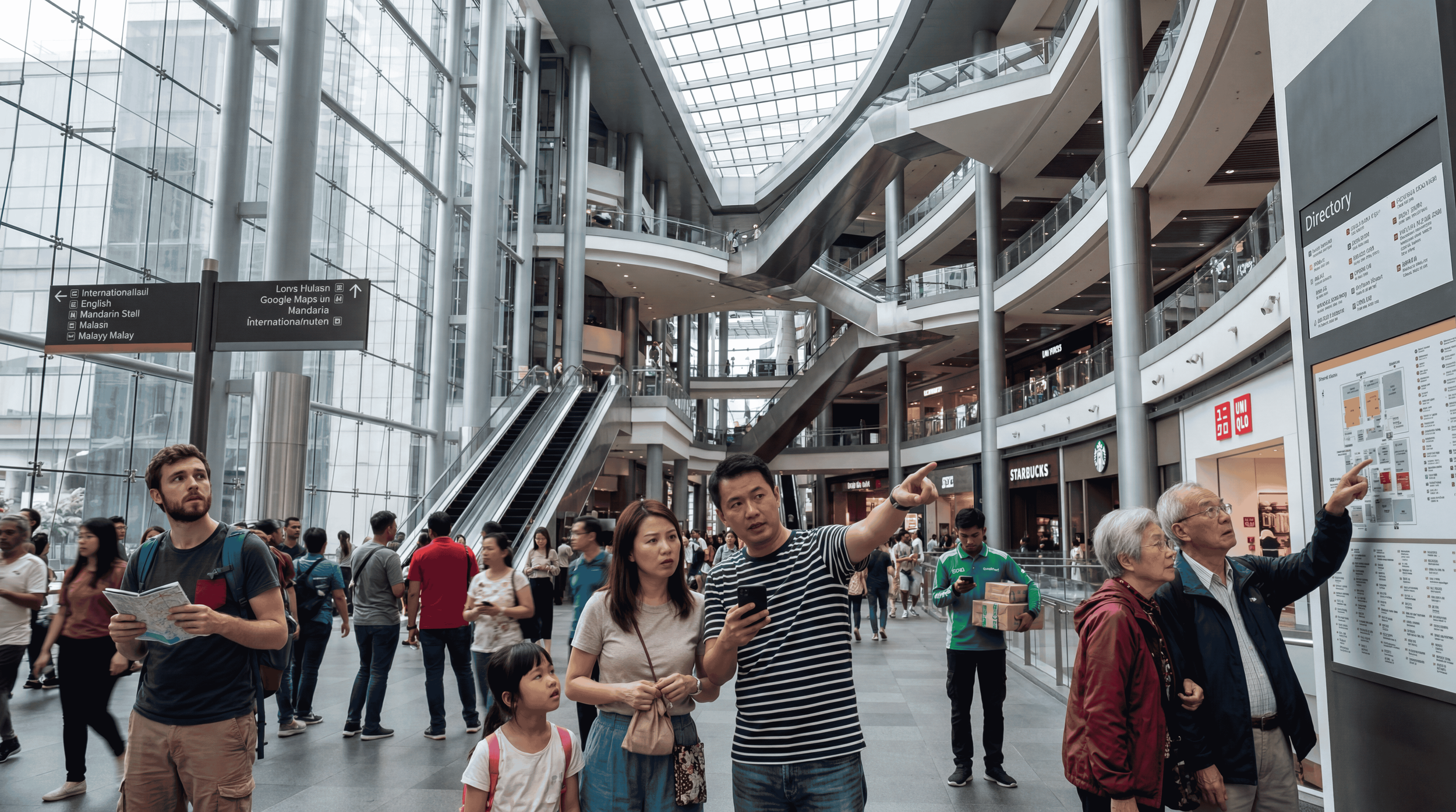
This can be seen in any number of ways across both small and large scale destinations and destination types. From simple residential towers where visitors are unable to find their friend's place, to retail malls that visitors swear they will never return to because of a poor car parking experience. When residents and guests cannot perform even the most basic of navigation tasks due to a poorly planned and executed wayfinding system, it usually comes down to the sad fact that nine times out of ten the visitor experience has either not been thought out properly — or worse — not even thought of at all.
The notion of providing a positive visitor experience and that of wayfinding has for a long time been looked upon as a luxury and not a necessity.
Regrettably for asset owners and operators, a lack of clear and understandable navigation that a bespoke wayfinding system can deliver greatly diminishes the visitor experience and creates a lasting negative perception of the destination. With that said, we do see the tide turning when it comes to focusing on delivering positive visitor experiences.
Smart operators already know that the two key drivers of differentiation in terms of visitor perception are their brand and the experience that they deliver. This is where a visitor experience consultant such as Creative Dialog comes in to provide an entire visitor-centric programme that puts the visitor first across every touchpoint of their journey.
As an asset owner it has never been so important to ensure that you provide an easy, inspiring, and on-brand user experience to residents, guests, visitors, and coworkers. And it is this — not the mega nature of an attraction itself — that will pay dividends into the future. Build it and they will come — but perhaps only once.
Future Trends.
As consumer trends develop away from the big and the bold, to more localised and meaningful experiences, along with increasing competition across all destination sectors, trying to gain the visitation and loyalty of time-pressed, discerning consumers is the new battle ground that developers are finding themselves on.
As such, today's asset owners and operators have little choice but to focus on service quality and differentiation to remain competitive. This means the core focus must be on delivering visitor-centric destinations that resonate with their guests, buyers, and end users.
This applies to residential communities, hotels and resorts, retail malls and mixed-use destinations alike, where the previous non-visitor-focused, cookie-cutter, one-size-fits-all destinations and attractions of yesterday are struggling to capture their former glory.
By linking the two critical destination factors of differentiation and experience and delivering visitor-centric, whole-journey experiences that are consistent and inspiring, visitor-experience-oriented practices like Creative Dialog are able to not only create a destination narrative and brand story in an exciting and innovative way, but we can also ensure that the visitor is provided greater levels of convenience and satisfaction on each visit.
It's important to remember that a poor visitor experience doesn't only impact the front-facing customer, but it can have an adverse effect on operational efficiency, staff productivity, as well as customer satisfaction.
In short, it diminishes the user's enjoyment of the destination, which can often go unnoticed until it's almost too late. Our goal is to understand the needs of people as they navigate the built environment and provide innovative solutions for our partners by establishing all of the areas where the visitor experience can be improved.
Truly great destinations are marked by their ability to deliver authentic experiences and inspire a deep connection between people and place. This is the kind of destination that we try to craft when developing our placemaking strategies.
Well-designed public spaces, either indoor or within the outdoor domain, promote more than just aesthetic values.
By really thinking about the audience, their desires and needs, we can activate these spaces in a way that is both meaningful and engaging to residents and visitors. At the same time, we can also create an authentic sense of place that promotes community cohesion and a shared sense of belonging. As an integrated visitor experience practice, our strategic and design criteria stipulates that the user experience must be stress-free and enjoyable, and by taking a holistic approach to any given destination we are able to uncover a range of areas to be improved and fine-tuned along the visitor journey. The financial benefits to our partners of doing so have proven to be substantial.
Bottom Line
In the experience economy, the ability to allow people to easily navigate and consume spaces is one of the key tenets of delivering a positive visitor experience. It is the confluence of place design, understanding of human behaviour, wayfinding, and the creative outcomes adopted across the built environment that shape the places we inhabit and make them either highly desirable and a must-go — or perhaps not.
As such, it is becoming increasingly obvious that when it comes to real-world experiences and habitats like the places we dwell, shop, or spend our leisure time and dollars in, consumers are increasingly looking for authenticity, meaning, and engagement, which has to be underpinned by ease of use and convenience. Whether they actively notice that these experiences have been curated for their benefit does not matter; the key is to ensure that they are delivered a positive visitor experience. Doing so is the first step in guaranteeing the future success of destinations, big or small, that put their visitors' needs first.
At Creative Dialog, with 30 years of industry experience across wayfinding, signage design, placemaking, and destination branding, we put people, strategy, and expertise at the forefront of what we do — to ensure that the visitor is always the hero. Where the visitor experience is underperforming, our Belonging Audit™ provides a structured assessment of how your destination performs against the four dimensions of belonging: Navigate, Recognise, Connect, Dwell.
Like What Your Reading?
These articles are a small part of our research and strategic advisory Services. Get in touch with Creative Dialog today to see how we can distill these insights into actionable strategies and solutions to improve the visitor experience across your destination.
Looking for deeper analysis of the Visitor Experience economy?
Read more over at Extended Dialog.