The Art of Placemaking in Asia Pacific: Creating Spaces That Tell Authentic Stories.
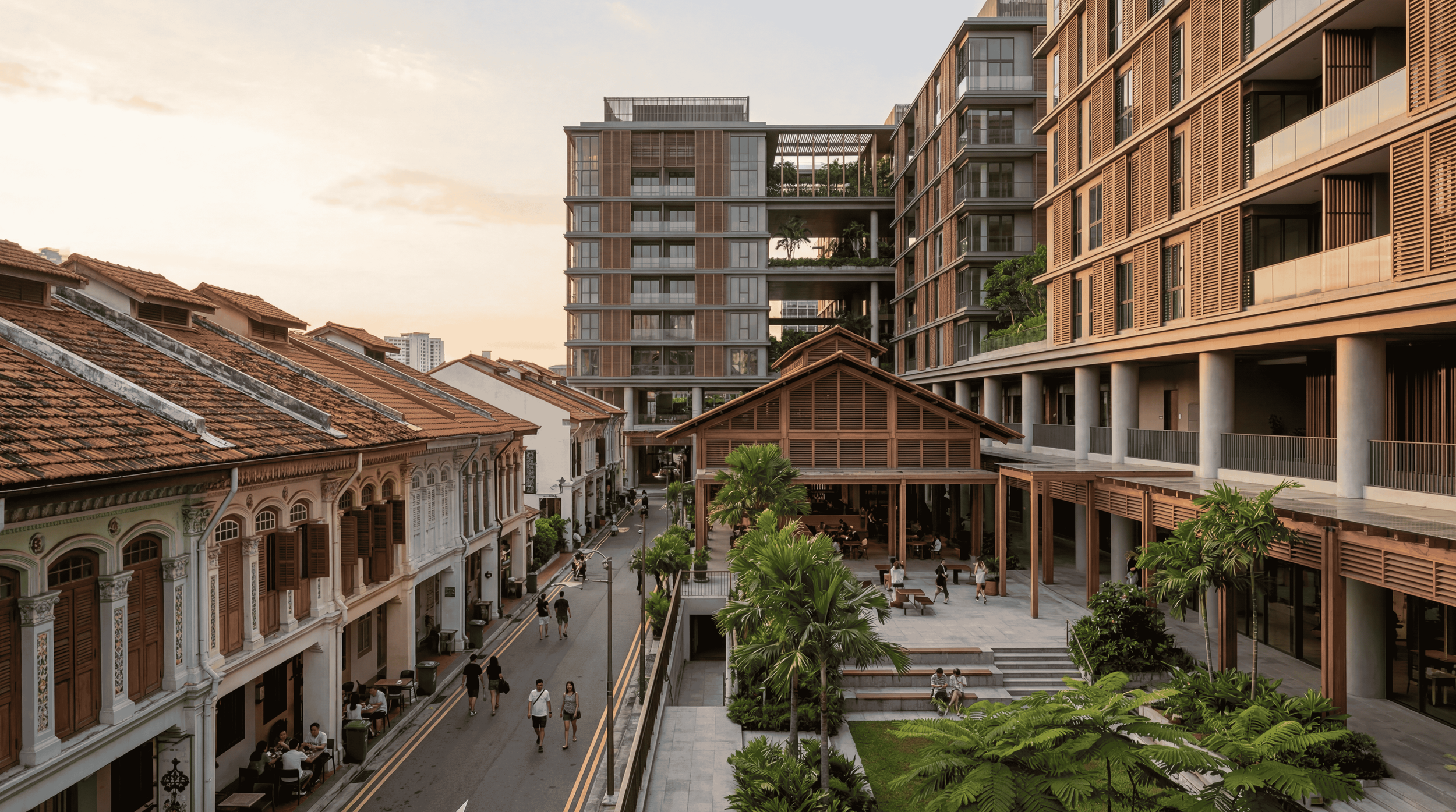
Creating Spaces That Tell Authentic Stories.
Asia-Pacific didn't need a global design movement to understand placemaking — the shophouse, the kampung, the courtyard house, and the kaki lima were masterclasses in it long before the term existed. But as the region's development ambitions accelerate, the gap between traditional spatial intelligence and contemporary delivery has become one of the industry's most pressing challenges.
In this post, Creative Dialog draws on more than a decade of integrated visitor experience practice — across some of the world's most complex destination environments and now applied across Asia-Pacific — to explore the four dynamics that consistently separate transformative places from forgettable ones, and why the destinations that will define the region's next chapter won't be those with the most dramatic architecture, but those that honour the principles that made its traditional urban forms enduringly powerful.
The region that gave the world the shophouse, the kaki lima, the kampung, and the courtyard house has always understood placemaking. The challenge now is translating that wisdom into contemporary developments without losing what made it work in the first place.
Asia-Pacific has always understood something fundamental about creating meaningful places. Long before "placemaking" entered the global design lexicon, the region's traditional urban forms demonstrated a sophisticated understanding of how physical environments shape human experience.
The shophouse wasn't just a built form — it was a complete urban system, integrating street-level commerce with upper-floor residence, climate-responsive air wells with the kaki lima covered pedestrian arcade, family enterprise with civic life. It produced the urban fabric that still defines the heritage cores of Singapore, Penang, Melaka, Hong Kong, Hoi An, Bangkok, and Yangon.
The kampung wasn't just a settlement — it was a climate response (raised on stilts for cross-ventilation and flood resilience), a social structure (the gotong royong communal-living pattern), and a transitional space discipline (the verandah as gathering point between private and public).
The courtyard house, in its many regional expressions — Chinese siheyuan, Korean hanok, Japanese machiya, Peranakan terrace — wasn't just an architectural feature. It was a climate response, a privacy mechanism, a multi-generational living strategy, and a gathering space all at once.
Today, as the region undergoes unprecedented development, there's an opportunity to bridge this centuries-old wisdom with contemporary innovation. And increasingly, the most informed developers are recognising that the most impactful destinations aren't defined by their architecture. They're defined by the experiences, connections, and narratives that emerge within and between buildings.
At Creative Dialog, we've spent decades working at this intersection — helping destinations uncover what makes them genuinely distinctive and translate that understanding into places people remember, return to, and recommend.
Reading the Layers
Effective placemaking begins with listening — to both people and place. In a region with such rich historical texture, every site contains stories waiting to be uncovered. The most compelling places don't impose narratives but reveal and amplify what's already present.
Consider how the strongest urban interventions in historic precincts like George Town in Penang, the Hoi An Ancient Town in central Vietnam, or Singapore's Tiong Bahru, Tanjong Pagar, and Joo Chiat heritage zones respect existing patterns while adding contemporary relevance. These projects succeed by identifying the authentic essence of a place — its distinctive character, rhythms, and social patterns — and evolving it thoughtfully rather than erasing and replacing.
George Town's UNESCO designation in 2008 didn't freeze the heritage core; the George Town Festival has activated it, contemporary street art has internationalised it, and second-generation Peranakan craftspeople run workshops in the same shophouse blocks as contemporary galleries and design studios. Hoi An's lantern-craft tradition has continued for centuries while evolving for contemporary visitor engagement. Singapore's heritage shophouse precincts demonstrate adaptive reuse at scale — original built form preserved, contemporary use layered on top.
Even in seemingly blank-slate developments, context matters. The surrounding landscape, cultural traditions, and community needs provide rich starting points. When we approach projects with genuine curiosity about local contexts rather than predetermined design solutions, unexpected insights emerge that can transform generic developments into memorable destinations.
The Four Dynamics
Through our work across complex destination environments, we've identified four dynamics that consistently distinguish transformative places from forgettable ones.
Temporal rhythm is the first and most regionally specific. Great places in Asia-Pacific understand and respond to the natural cadence of daily life — from the dawn rhythm of morning markets to the slow buildup and late-evening peak of hawker-centre dining, from the quiet of weekday mornings to the energy of weekend nights, from the seasonal pulse of Lunar New Year and Hari Raya through Diwali, Vesak, and the cherry-blossom hanami moments that move the rhythms of public space at specific times of year.
Designing with these temporal patterns creates places that feel alive because they move with the culture rather than against it. A shophouse precinct that closes its commercial frontages at 6pm misunderstands itself; one that activates evening F&B and night markets aligns with how communities have used these spaces for generations.
Sensory engagement extends far beyond visual design. The most memorable places activate all senses — the fragrance of pandan leaves and frangipani, the acoustic quality of gathering spaces, the tactile richness of materials, the play of light and shadow through screens, eaves, and tropical canopies.
In Asia-Pacific, where the sensory landscape includes the multi-faith soundscape of cities like Singapore (where temple bells, the adhan from neighbourhood mosques, Hindu temple drums, and Buddhist chanting coexist within walking distance), the percussive cadence of hawker-centre and wet-market commerce, the aromatic announcements of kopi roasting and satay smoke and laksa broth before any visual cue arrives, and the petrichor of monsoon rain on tropical foliage and tile rooftops — these elements create emotional architecture that visitors carry with them long after departure.
Social choreography subtly guides human interaction through spatial arrangement. The hierarchy of spaces — from intimate nooks for private conversation to expansive plazas for community celebration — facilitates connection at multiple scales. The kopitiam (or kedai kopi in Malay-Indonesian contexts) tradition of communal coffee-and-conversation across generations, reinterpreted for contemporary contexts, demonstrates how culturally grounded social design creates spaces that feel instinctively right for their communities. So does the kampung verandah as transitional social space, the kaki lima as continuous social-and-commercial fabric, and the Japanese genkan threshold as the considered moment of transition between outdoor and indoor identity.
Narrative integration is the thread that connects every element into a coherent experience. Every successful place tells a story that resonates with its context — drawing from historical events, cultural traditions, or contemporary aspirations. When architecture, wayfinding, public art, and programming all express the same narrative, they create multidimensional experiences that engage visitors intellectually and emotionally. When they contradict each other, even subtly, visitors sense the disconnection.
Cultural Activation: Art as Catalyst
Art has emerged as a particularly powerful placemaking tool across Asia-Pacific, creating distinctive identity while facilitating deeper engagement with place. But the most effective artistic strategies have moved far beyond decorative additions. As a region, the discipline has progressed well past placing an obligatory batik motif or a stylised dragon onto a wall in an attempt to create a sense of place.
Today, the leading placemaking practitioners commission work that interprets regional heritage, involves community participation, and responds to specific site conditions in deeply thoughtful ways. The result is places with genuine soul and substance — light years from the painting-by-numbers approach of just a few years ago.
George Town's contemporary street art, sensitively integrated into the heritage shophouse fabric, drew international visitors not because it was decorative but because it was thoughtful. Hong Kong's PMQ — the adaptive reuse of the former Police Married Quarters as a creative precinct — demonstrates how cultural activation programming, layered onto carefully preserved heritage architecture, transforms a single building into a destination. Tai Kwun, Hong Kong's former Central Police Station compound, does the same at larger scale. Place visioning and branding done right can deliver unique experiences imbued with authentic moments that can't be replicated elsewhere.
This has particular commercial significance. Consumers increasingly seek experiences that offer authenticity and substance — places that tell stories worth sharing and revisiting. For asset owners and operators, this drives organic social media amplification of the brand story and, critically, repeat patronage and sustained consumer spend.
Measuring Beyond the Obvious
As the discipline matures across Asia-Pacific, so too must approaches to evaluating success. Forward-thinking clients are moving beyond simple visitor counts to embrace more nuanced evaluation frameworks.
Dwell time reveals how long visitors genuinely engage with a place — not just pass through it. Return visitation indicates deep engagement rather than one-time curiosity. Social media behaviour shows which aspects of the experience resonate most strongly and how visitors describe the place to their networks. Community formation indicates whether a place is fostering ongoing relationships. Economic ripple effects measure impact on surrounding areas and businesses.
The most sophisticated projects also evaluate success through qualitative factors — emotional response, cultural impact, and the fundamental question of whether people experience the place as something worth their time and attention. Understanding how visitors actually feel about a destination, which signature moments define it in their memory, and where friction undermines positive perception provides the insight needed to refine and evolve.
These measurement approaches ensure that placemaking investment is evaluated on its actual impact rather than assumptions, creating the evidence base for continued investment in experience quality.
Looking Forward
Several emerging directions will shape the next generation of Asia-Pacific placemaking. Climate-responsive design will become increasingly sophisticated — not just providing shade and cooling, but creating comfortable outdoor environments through passive strategies, microclimate engineering, the considered integration of covered linkway networks (as Singapore has done at urban scale), and the temporal activation that allows public realm use across monsoon seasonality and tropical heat.
Digital-physical integration will create new possibilities for personalisation, storytelling, and hidden narrative layers that augment physical experience without overwhelming it. Community co-creation will move beyond consultation to active partnership, with residents shaping places that carry genuine relevance. And cross-cultural exchange — already a defining characteristic of Asia-Pacific's port cities and trade-route heritage — will continue to produce environments that feel simultaneously rooted in local tradition and connected to global contemporary practice.
The places that will matter most in this region's next chapter won't be those with the most dramatic architecture or the largest floor plates. They'll be the ones that honoured the same principles that made the shophouse, the kaki lima, the kampung, and the courtyard house enduringly powerful: designing for human experience, responding to climate and culture, and creating the conditions for genuine connection.
Where authentic placemaking has yet to be excavated — or where existing identity work needs revisiting against the four dimensions of belonging — our Belonging Audit™ provides a structured starting point: assessing how a place performs against the dimensions that matter — Navigate, Recognise, Connect, Dwell.
Like What Your Reading?
These articles are a small part of our research and strategic advisory Services. Get in touch with Creative Dialog today to see how we can distill these insights into actionable strategies and solutions to improve the visitor experience across your destination.
Looking for deeper analysis of the Visitor Experience economy?
Read more over at Extended Dialog.